
← Wonder EngineWonder no. 26Stranger beasts6min read
Why the Coelacanth Was Extinct for 66 Million Years, Until a 1938 Fishing Trawler Caught One
The story behind the wonder.
A lineage missing from the fossil record for 66 million years turned up alive in a 1938 trawler haul off South Africa. It had never left.
Published
UTC
Reading time
6 min
~210 wpm
Word count
1,292
plain English
Category
Stranger beasts
stranger-beasts
On 22 December 1938, a 31-year-old museum curator in East London, South Africa, leaned over a heap of sharks and rays on a trawler deck and lifted out a 1.5 metre, mauve-blue fish whose lineage had been missing from the rock record for 66 million years.
A Curator, a Trawler, and a Fish That Should Not Exist
The trawler was the Nerine, commanded by Captain Hendrik Goosen, and it had docked in East London with bycatch hauled near the mouth of the Chalumna River. Marjorie Courtenay-Latimer, curator of the East London Museum, was called down to see if there was anything worth keeping. What she found instead was a fish she could not place against anything in the museum's literature. She would later describe the moment plainly: "I picked away the layers of slime to reveal the most beautiful fish I had ever seen. It was five feet long, a pale mauvy blue with faint flecks of whitish spots; it had an iridescent silver-blue-green sheen all over. It was covered in hard scales, and it had four limb-like fins and a strange puppy dog tail."
The animal she had her hands on belonged to the subclass Actinistia, a group that had vanished from the fossil record at the Cretaceous-Paleogene boundary, the same mass extinction event that ended the non-avian dinosaurs. Every textbook of the era listed it as gone. The specimen on the dock was not.
The practical problem came next. The town mortuary refused the fish. The local cold-storage warehouse refused the fish. Courtenay-Latimer loaded the specimen into a taxi and brought it back to her museum, where she handed it to the local taxidermist, Robert Center. He wrapped the body in formalin-soaked newspaper and bedsheets in an attempt to slow the decay, but by 27 December the soft tissues had begun to spoil, and Center was forced to skin and gut the fish purely so something could be mounted. The internal organs were lost. The skin, the skeleton, and the gills were not.
A Telegram From J.L.B. Smith
Courtenay-Latimer mailed a sketch of the fish to the ichthyologist J.L.B. Smith at Rhodes University. Smith's reply was a telegram that has since become famous in zoology: "Most important preserve skeleton and gills = fish described." He could not get to East London immediately, and the months between the sketch and his arrival were spent worrying that whatever the curator had recovered would be lost to rot before he could see it himself.
He finally examined the preserved specimen in person on 16 February 1939. His reaction was unambiguous: "There was not a shadow of a doubt. It could have been one of those creatures of 200 million years ago come alive again." Later that year, he named the species Latimeria chalumnae, the genus honouring Courtenay-Latimer and the species name commemorating the river.
What followed was a long and unsatisfying silence. The world had its first living coelacanth, but it would be 14 years before a second one was landed, in December 1952, near the Comoro Islands between Madagascar and Mozambique. The pace did not pick up after that either. Between 1938 and 1975, only 84 coelacanth specimens were caught and recorded in the entire world. For an animal that had returned from a 66-million-year absence, it remained extraordinarily reluctant to be seen.
A Second Species, 10,000 Kilometres Away
In September 1997, the American marine biologist Mark V. Erdmann spotted an unfamiliar coelacanth being wheeled through a fish market in Manado, on the Indonesian island of Sulawesi. The fish was more than 10,000 kilometres from the established African range. A second Indonesian specimen was secured in July 1998, and the new species was formally described in 1999 as Latimeria menadoensis. The two living species are now the only surviving members of the genus Latimeria; everything else in their class is known only from fossils.
The fossil record itself reaches back further than almost any other vertebrate story. The oldest identified coelacanth specimens are dated to roughly 410 to 420 million years ago, in the early Devonian, older than any tree, any dinosaur, and any land vertebrate. The group reached its peak diversity in the Early Triassic, then declined steadily across the Mesozoic before disappearing from the rock record at the close of the Cretaceous. For 66 million years after that, there was nothing. Then a trawler net in 1938, and a fish market in 1997.
Anatomy Found Nowhere Else
The reason the coelacanth was recognisable as something ancient, even on a museum bench in 1939, is that its body carries hardware no other living vertebrate retains. There is an intracranial joint in the skull, a physical hinge between the front and back halves of the braincase that allows the front portion to articulate upward on its own. Beneath the skull, the spine is not a spine. The coelacanth retains an oil-filled notochord, a hollow, pressurised tube of fluid running the length of the body in place of fully ossified vertebrae, a structure shared with the earliest jawed vertebrates. In the snout sits the rostral organ, a gel-filled cavity that detects weak electrical fields from prey hidden in dark water.
The behaviour is as strange as the anatomy. Coelacanths are nocturnal drift-hunters that float in near-motionless ambush, occasionally orienting themselves head-down, belly-up, or backwards to probe submarine caves for cuttlefish, squid, snipe eels, and small sharks. They are the only living vertebrates with this exact toolkit, navigating and hunting in a sensory environment most fish cannot enter.
Reproduction was misread for nearly four decades. The coelacanth was assumed to lay eggs until 1975, when scientists at the American Museum of Natural History dissected a captured female and found five large embryos already developing inside her. The species gives birth to live young, with litters of between 5 and 25 fully formed pups. A 2021 study of growth rings in coelacanth scales went further, concluding that gestation lasts approximately five years, the longest gestation period known in any vertebrate animal. The same study revised the species' lifespan upward to roughly 100 years and pushed estimated age at sexual maturity to about 20. The coelacanth lives on a biological clock so slow that a single pregnancy outlasts most household decisions.
A Living Lineage in an Industrial Ocean
Latimeria chalumnae is now listed as Critically Endangered on the IUCN Red List. Latimeria menadoensis is listed as Vulnerable. The primary threat to both species is accidental capture in commercial deep-sea trawl nets. The flesh of a coelacanth is inedible, full of urea, oils, and wax esters, so there is no market for the fish beyond museums and private collectors. The species is hauled up by mistake, not by demand, and that has been enough to put both populations under pressure.
Marjorie Courtenay-Latimer, born on 24 February 1907, died on 17 May 2004 at the age of 97. She lived long enough to watch the fish she pulled out of a heap of bycatch in East London become one of the most famous biological discoveries of the twentieth century, and to see a second species turn up in an Indonesian market across an entire ocean. The lineage she named had been there the whole time, generation after generation, in deep reef caves below the reach of nets and below the reach of attention. It was not brought back. It was never gone. The story of the coelacanth is not a resurrection. It is a record of how long an animal can keep its own counsel when nobody is looking deep enough to find it.
Sources
// Sources · primary references
03 refs- Wikipedia: Coelacanthen.wikipedia.org
- Wikipedia: Marjorie Courtenay-Latimeren.wikipedia.org
- Wikipedia: Lazarus taxonen.wikipedia.org
// More from Stranger beasts
See category →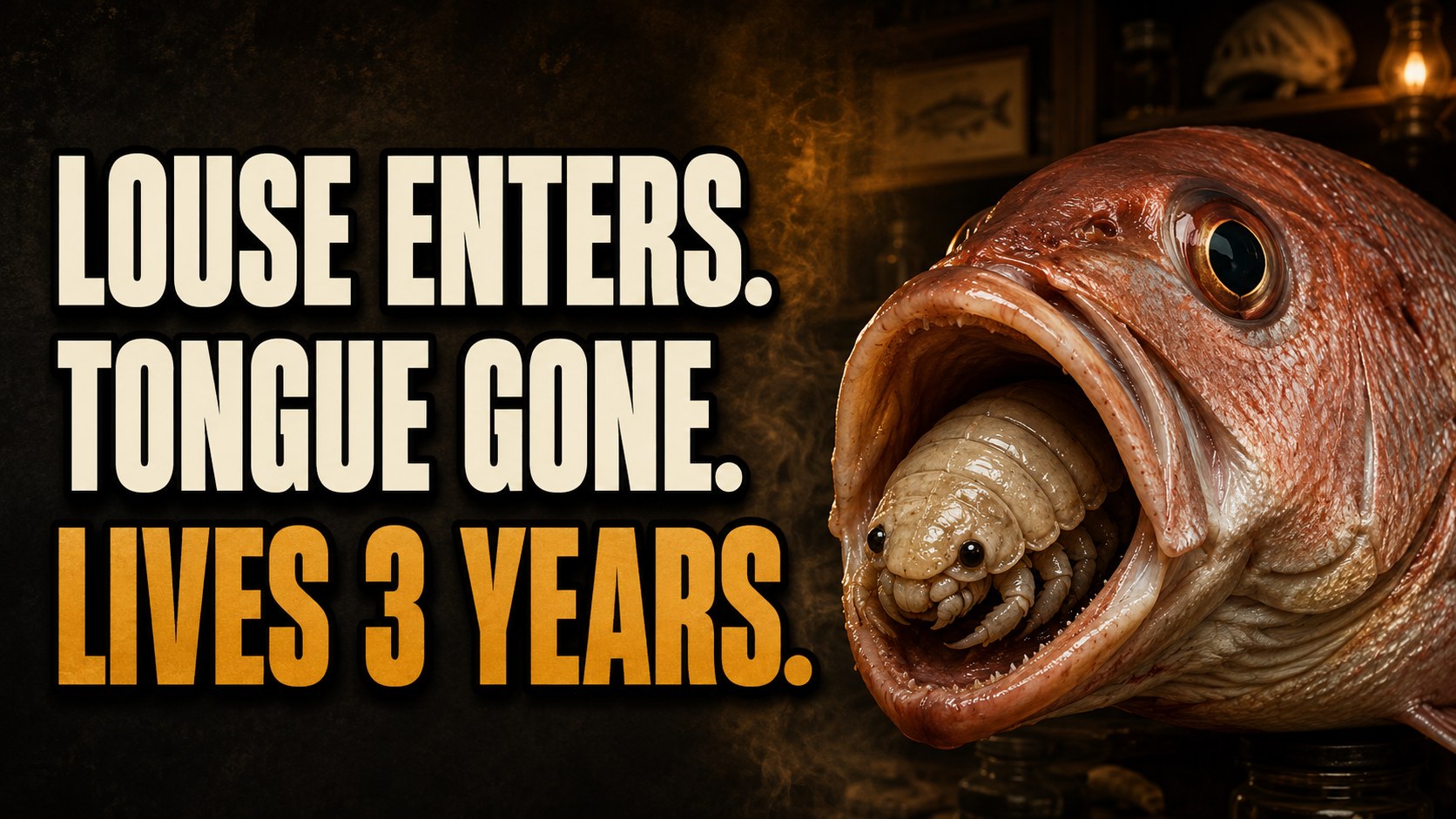
The Parasite That Replaces a Fish's Tongue: Cymothoa exigua
A small isopod off Costa Rica severs a snapper's tongue, waits for the tissue to die, and clamps itself into the socket for up to three years.
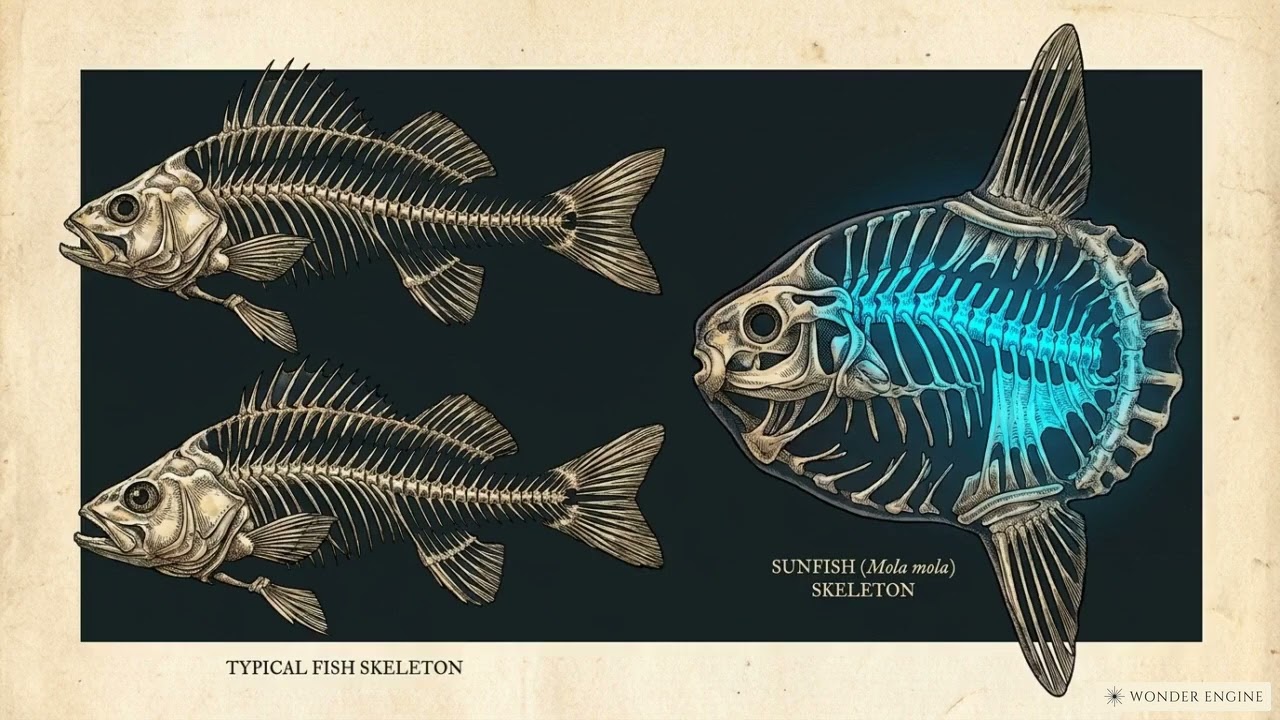
The Ocean Sunfish Releases 300 Million Eggs and Still Loses Ground
A single Mola mola female carries up to 300 million eggs, the highest fecundity in any vertebrate, yet the species is now listed as Vulnerable.

Why the Aye-Aye Taps Trees Eight Times a Second
The aye-aye survived being declared extinct in 1933. Today it is killed on sight in Madagascar for the very finger that keeps it alive.