
← Wonder EngineWonder no. 24Stranger beasts6min read
The Electric Eel That Fires 860 Volts and Hunts in Packs
The story behind the wonder.
For 250 years biologists thought the electric eel was a lone hunter. In 2021, a team in the Amazon watched it work in coordinated packs.
Published
UTC
Reading time
6 min
~210 wpm
Word count
1,243
plain English
Category
Stranger beasts
stranger-beasts
The fish that lent its anatomy to the vocabulary of the battery turns out to have been hiding a second secret, and biologists only caught it on camera five years ago.
The number that opens the file
In 2019, biologists confirmed that a newly recognised species of electric eel, Electrophorus voltai, can deliver 860 volts in a single pulse lasting roughly two milliseconds. That figure stands as the highest voltage ever measured in any animal on Earth. It is produced by a creature that is not, in any meaningful biological sense, an eel. The animal belongs to the order Gymnotiformes, the South American knifefishes, which makes it more closely related to a catfish than to anything in the order Anguilliformes.
For more than 250 years that distinction was the most interesting thing about it. Carl Linnaeus described it as a single species, Gymnotus electricus, in 1766. In 1864 Theodore Gill moved it into the genus Electrophorus, a name stitched together from the Greek ḗlektron, amber, and phérō, "I carry": literally, the bearer of electricity. The taxonomy held for a century and a half. Then in 2019 the ichthyologist Carlos David de Santana and colleagues split Electrophorus into three species, E. electricus, E. voltai, and E. varii, divided across the Guiana Shield, the Brazilian Shield, and the lowland river basins. Genetic dating placed the divergence of E. varii from the rest of the genus at roughly 7.1 million years ago in the late Miocene; E. electricus and E. voltai split about 3.6 million years ago in the Pliocene. A basic taxonomic error had lasted two and a half centuries, and as the next part of the story shows, it was only the first oversight.
A body redesigned around a battery
E. voltai reaches 2.5 metres, or 8 feet 2 inches, and weighs up to 22 kilograms, about 49 pounds. The animal lives in turbid, low-oxygen rivers and swamps where vision is almost useless, water heavy with silt and stained brown by tannins. It cannot extract enough oxygen from the water itself and must break the surface to gulp atmospheric air roughly every two minutes. Inside the mouth, a frilled, blood-rich mucosa absorbs oxygen directly into the bloodstream, while the majority of carbon dioxide leaves through the skin.
Almost everything inside the body has been pushed aside to make room for the electrical apparatus. Vital organs, the heart, liver, and gut, are compressed into just 20 percent of the body cavity. The remaining 80 percent is given over to three pairs of electric organs running most of the length of the animal: the main organ, Hunter's organ, and the much smaller Sachs' organ. The vertebral column is in keeping with the elongation. An adult has more than 100 precaudal vertebrae and as many as 300 in total, among the highest counts of any fish. Along the underside, the anal fin contains over 400 bony rays, undulating to propel the animal forward or backward with equal ease.
The electric organs themselves are built from modified muscle cells called electrocytes, stacked like the cells of a chemical battery. The main organ contains roughly 6,000 electrocytes in series, with about 35 such stacks running in parallel on each side of the body. When the system discharges, the animal can fire pulses at up to 500 hertz. A single high-voltage pulse carries roughly 1 ampere at around 500 volts; in E. voltai the peak measured discharge reaches 860 volts. The much smaller Sachs' organ, by contrast, produces low-voltage pulses near 10 volts at about 25 hertz, used not for attack but for electrolocation, the animal reading distortions in its own field through lateral-line electroreceptors to navigate water where it cannot see.
Hunter, Humboldt, Faraday, and the borrowed name
The first written European description came in 1583, when the Jesuit priest Fernão Cardim recorded the indigenous Tupi name puraké, "the one that numbs." European laboratories took two more centuries to catch up. In 1775 the surgeon John Hunter dissected a specimen in London and opened his paper to the Royal Society with the line, "Gymnotus Electricus appears very much like an eel but it has none of the specific properties of that fish." The body, he reported, contained "two pair of these organs, a larger and a smaller; one being placed on each side." The third, low-voltage organ that now bears the name Sachs' organ was not described until the German physiologist Carl Sachs published his anatomical work in 1877.
The fieldwork was just as visceral. In 1800, Alexander von Humboldt watched local fishermen drive horses into a flooded pool to draw out the eels' first, most powerful discharges; he reported that two of the horses were stunned by the shocks and drowned. By 1839, Michael Faraday had spent four months in London measuring the discharge of a captive specimen, comparing the charge to a "Leyden battery of fifteen jars."
Running alongside the biology, the physics was assembling the same architecture from copper and zinc. Alessandro Volta published the design of the voltaic pile in 1799, and on 20 March 1800 wrote to the Royal Society in London describing how stacked discs of copper and zinc, separated by brine-soaked cloth, produced a steady electric current. Stacked cells in series, separated by an electrolyte: the mechanical structure mirrored the biology nature had already arrived at. Two centuries later, when de Santana's team identified the strongest bioelectricity generator known to science, they named it Electrophorus voltai in Volta's honor. The species took its name back from the invention it resembled.
What two centuries of textbooks missed
Every description from Hunter forward assumed the same thing about behaviour: a predator armed with an overwhelming lethal discharge would naturally hunt alone. Field observers had cataloguing material that fit the picture, watching eels leap out of the water along the body of a horse or a caiman, pressing the chin against the target to drive the full discharge directly into a terrestrial animal. The animal looked like a solitary weapon.
In 2021, a paper by Carlos David de Santana and colleagues, published in the journal Ecology and Evolution, dismantled that assumption. Working at the mouth of the Iriri River in the Brazilian Amazon, the team documented a population of E. voltai doing something no electric fish had ever been seen to do. The authors wrote that "E. voltai…have been observed targeting a shoal of tetras, then herding them and launching joint strikes on the closely packed fish." It was the first known occurrence of pack hunting in any electric fish.
The implication is straightforward and uncomfortable. The discharge had been measured, the anatomy mapped, the species split and renamed, and the textbooks updated, all without anyone noticing that the most powerful electric animal on Earth was also a cooperative predator. The lifespan in captivity is over 20 years; the species reproduces in nests built from the male's saliva, with about 1,200 eggs per clutch, a 7-day incubation, and an unusually long four months of paternal care guarding the nest. The social depth was sitting in the reproductive record. The hunting behaviour was sitting in the river. It took until 2021 for someone to film it.
The fish that taught the world how a battery works was the same fish whose social life nobody had bothered to watch.
Sources
// Sources · primary references
03 refs- Wikipedia: Electric eelen.wikipedia.org
- Wikipedia: Electrophorus voltaien.wikipedia.org
- Wikipedia: Voltaic pileen.wikipedia.org
// More from Stranger beasts
See category →
The Parasite That Replaces a Fish's Tongue: Cymothoa exigua
A small isopod off Costa Rica severs a snapper's tongue, waits for the tissue to die, and clamps itself into the socket for up to three years.
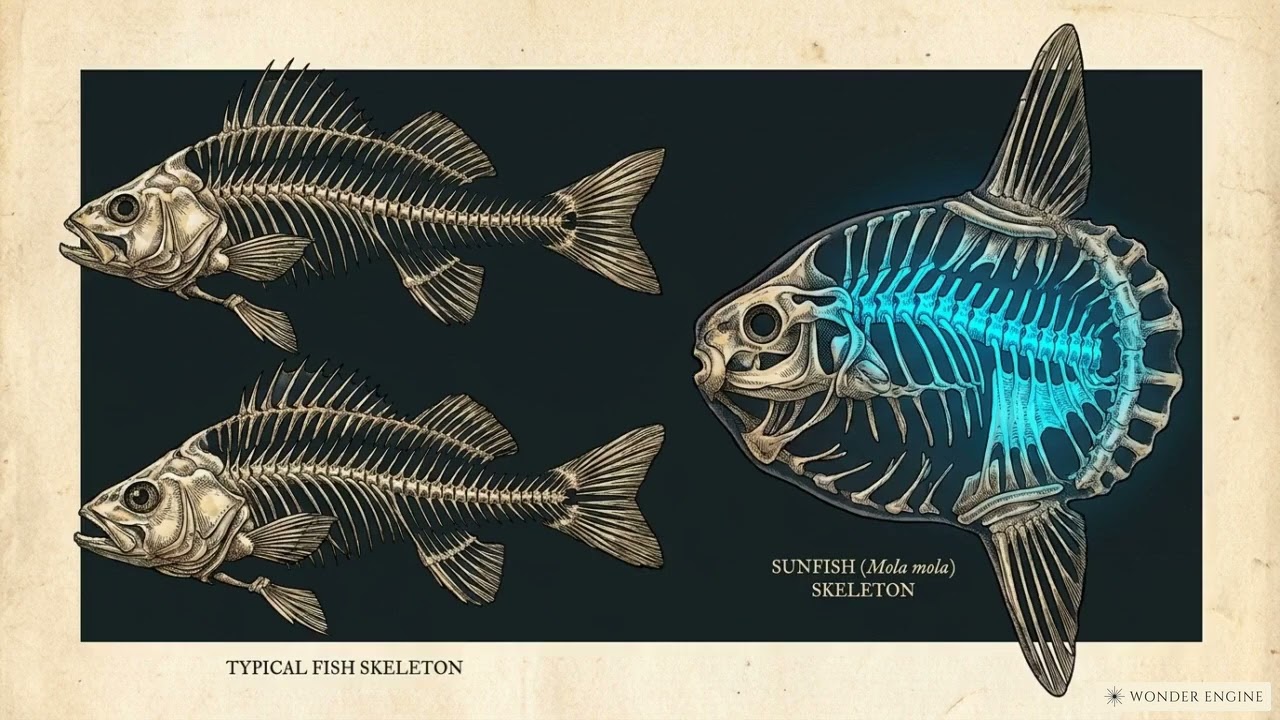
The Ocean Sunfish Releases 300 Million Eggs and Still Loses Ground
A single Mola mola female carries up to 300 million eggs, the highest fecundity in any vertebrate, yet the species is now listed as Vulnerable.

Why the Aye-Aye Taps Trees Eight Times a Second
The aye-aye survived being declared extinct in 1933. Today it is killed on sight in Madagascar for the very finger that keeps it alive.