
← Wonder EngineWonder no. 14Stranger beasts6min read
The 392-Year-Old Shark That Cannot See
The story behind the wonder.
A Greenland shark dated to 392 years old is the longest-lived vertebrate science has measured, and it cannot outbreed 3,500 bycatch deaths a year.
Published
UTC
Reading time
6 min
~210 wpm
Word count
1,184
plain English
Category
Stranger beasts
stranger-beasts
A single Greenland shark, alive today, may have been swimming the Atlantic before the United States was a country, and almost certainly cannot see the water it is moving through.
The number that rewrote the vertebrate record
In August 2016, an age-determination study published in Science placed one individual Greenland shark at 392 ± 120 years old. The measurement, led by Julius Nielsen and colleagues, gave the species (Somniosus microcephalus) the longest confirmed lifespan of any vertebrate on record, with an estimated maximum lifespan stretching between 272 and 512 years. For comparison, the longest-lived mammal known to science, a bowhead whale, was found to be approximately 211 years old. Only one animal class reaches further back in time than a Greenland shark: the ocean quahog clam Arctica islandica, with a maximum recorded age of 507 years.
What makes the shark's number defensible is not estimation but chemistry. The Nielsen team did not guess at growth rings or extrapolate from size. They radiocarbon-dated the crystallin proteins inside the eye lenses of 28 Greenland sharks that had been killed as bycatch. Those proteins are laid down before birth and never replaced by the body. They are a biological time capsule, sealed at the moment of formation, carrying the carbon-14 signature of the year the shark was born. The lens, in other words, is older than every other tissue in the animal that wraps around it.
A body built for cold and patience
The Greenland shark lives in places that punish speed. It cruises in waters between minus 1.1 and 7.4 degrees Celsius, typically at depths between 100 and 1,200 metres, though one individual was observed at 2,200 metres near the wreck of the SS Central America. A separate record placed one in the Gulf of Mexico at 1,749 metres in August 2013. In that cold and pressure, the energy budget is austere, and the shark spends it slowly.
Its average cruising speed is roughly 0.34 metres per second, about 1.2 kilometres per hour, which makes it the slowest fish of comparable size ever measured. Its fastest recorded cruising speed reaches only about 0.74 metres per second. Its annual growth rate is between 0.5 and 1 centimetre per year, slower than any other shark studied. Multiplied across centuries, that crawl yields enormous animals: adults typically reach 4 to 5 metres in length, and the largest confirmed specimen measured 6.4 metres and weighed approximately 1,023 kilograms.
Almost every adult Greenland shark is also functionally blind. Its corneas are colonised by a parasitic copepod called Ommatokoita elongata, which anchors itself to the eye and causes corneal ulceration, mineralization, and edema. The retina underneath is rod-dominated, with a tapetum lucidum that scavenges photons in near-darkness, and only one set of cone-specific phototransduction genes (grk7) has been identified in the genome. The shark, in effect, has given up on vision the way it has given up on speed. It moves through dim water with most of its lens clouded, and that arrangement has worked for it for at least four centuries at a time.
Reading a life out of the proteins in the eye
The biology underneath the measurement is the part most worth pausing on. Crystallin proteins are metabolically inert after they are laid down. They are not turned over, not refreshed, not repaired. Whatever carbon-14 they captured at the moment they formed remains with them for the life of the animal. That property is what made the 2016 study possible: the team isolated carbon-14 in the lens nuclei of 28 bycaught sharks, calibrated against known atmospheric carbon-14 records (including the bomb-pulse signature from mid-20th-century nuclear testing), and back-dated each animal's year of birth.
The data revealed a second number that may matter even more than the first. Females do not reach sexual maturity until they are approximately 150 years old, at a body length of about 4.19 ± 0.04 metres; males reach maturity at around 2.84 ± 0.06 metres. That is the latest age of sexual maturity known in any vertebrate. The reproductive cycle that begins after that delay is itself long. Gestation in this species is estimated to last between 8 and 18 years. Litters can include up to 10 pups, each measuring 38 to 42 centimetres at birth. Across her entire multi-century lifespan, a single female may produce a total of 200 to 700 pups.
A vertebrate that spends a century and a half growing into adulthood is not built for fast recovery. It is built for centuries of equilibrium in a habitat where almost nothing else can compete.
A genome for repair, a flesh that fights back
The Greenland shark genome, published in 2024, runs to 6.45 billion base pairs. More than two-thirds of it is composed of transposable elements, and within the coding regions are 81 unique genes specifically linked to DNA repair. The flesh of the animal is, by ordinary standards, inedible. It carries high concentrations of urea and trimethylamine N-oxide (TMAO), which metabolises into trimethylamine, a uremic toxin, if the meat is eaten fresh.
Icelanders learned, centuries ago, to bypass that chemistry. Greenland shark is the basis of hákarl, the national dish of Iceland. The shark is gutted, beheaded, and buried in gravel under stones that press the toxic fluids out. It ferments under that weight for six to twelve weeks, during which urea converts to ammonia and TMAO drains away as liquid. It is then hung to dry for four to five months. A brown crust forms during drying and is trimmed away before the cured meat is served in small cubes, often alongside the local spirit brennivín.
The dish has earned the strongest possible opinions. Anthony Bourdain described it as "the single worst, most disgusting, and terrible-tasting thing." Andrew Zimmern, by contrast, called it "sweet, nutty, and only faintly fishy." Both reactions describe the same cured flesh of an animal whose genome is, in some literal molecular sense, dedicated to refusing damage.
A timescale that does not bend
The species is listed as Vulnerable on the IUCN Red List (3.1). Iceland's artisanal fisheries land roughly 25 Greenland sharks per year, a number small enough to sit inside the species' historical relationship with humans. The number that does not is the industrial bycatch figure: across the Arctic and North Atlantic, roughly 3,500 Greenland sharks are pulled from the sea each year as accidental catch in fleets that are not targeting them.
A vertebrate that requires 150 years to produce one breeding adult cannot replace 3,500 losses on any human timescale. The arithmetic does not bend. The same slow metabolism that allowed the Nielsen study to find a 392-year-old animal in 2016 makes the species mathematically incapable of recovering from industrial-scale losses inside a generation, where one generation, for this shark, is longer than industrial fishing has existed. That is the paradox the eye-lens proteins exposed: an animal whose single individual outlives empires, in a population that cannot outbreed a season of trawlers.
Sources
// Sources · primary references
03 refs- Wikipedia — Greenland sharken.wikipedia.org
- Wikipedia — Hákarlen.wikipedia.org
- Wikipedia — Longevityen.wikipedia.org
// More from Stranger beasts
See category →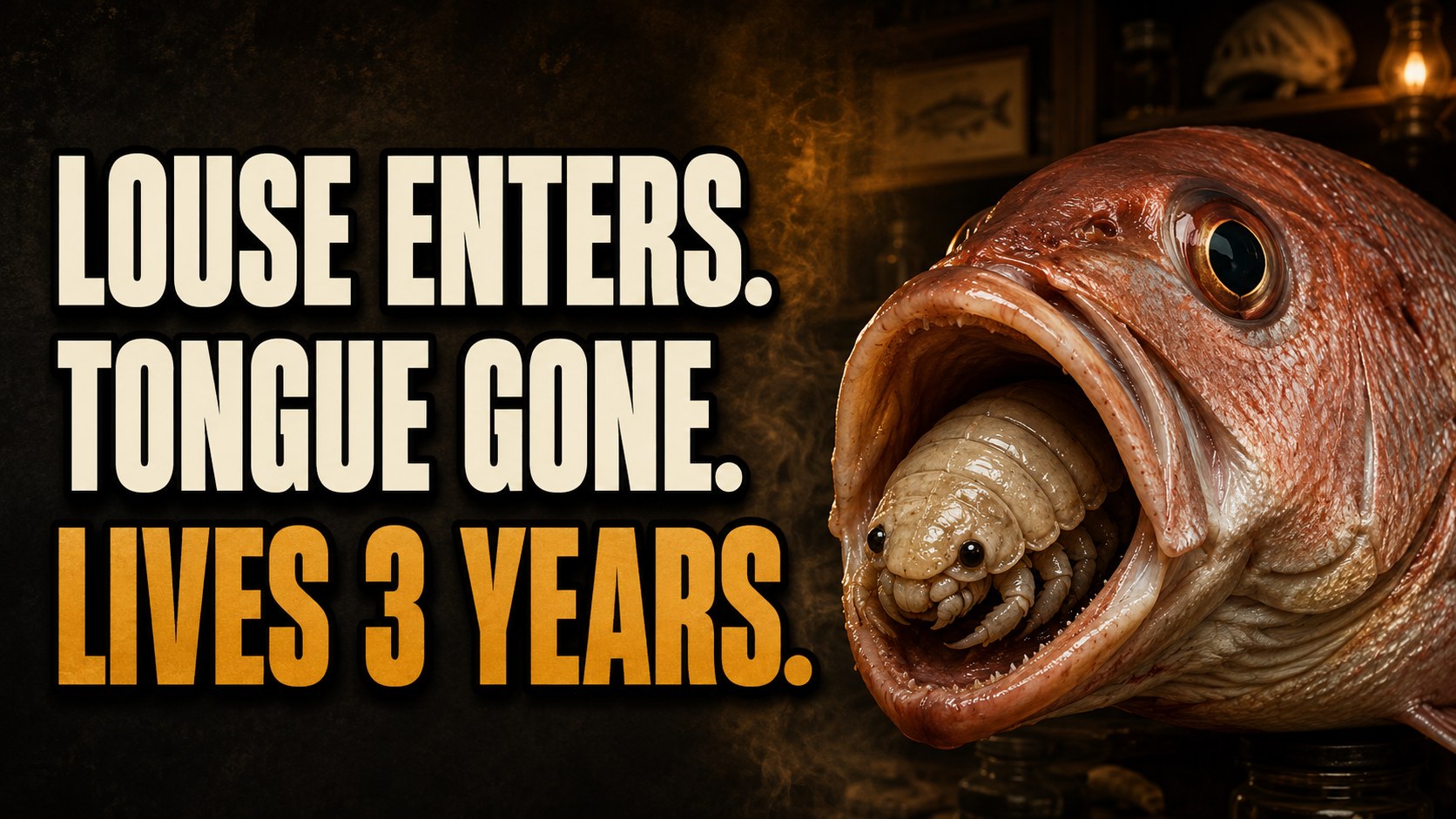
The Parasite That Replaces a Fish's Tongue: Cymothoa exigua
A small isopod off Costa Rica severs a snapper's tongue, waits for the tissue to die, and clamps itself into the socket for up to three years.
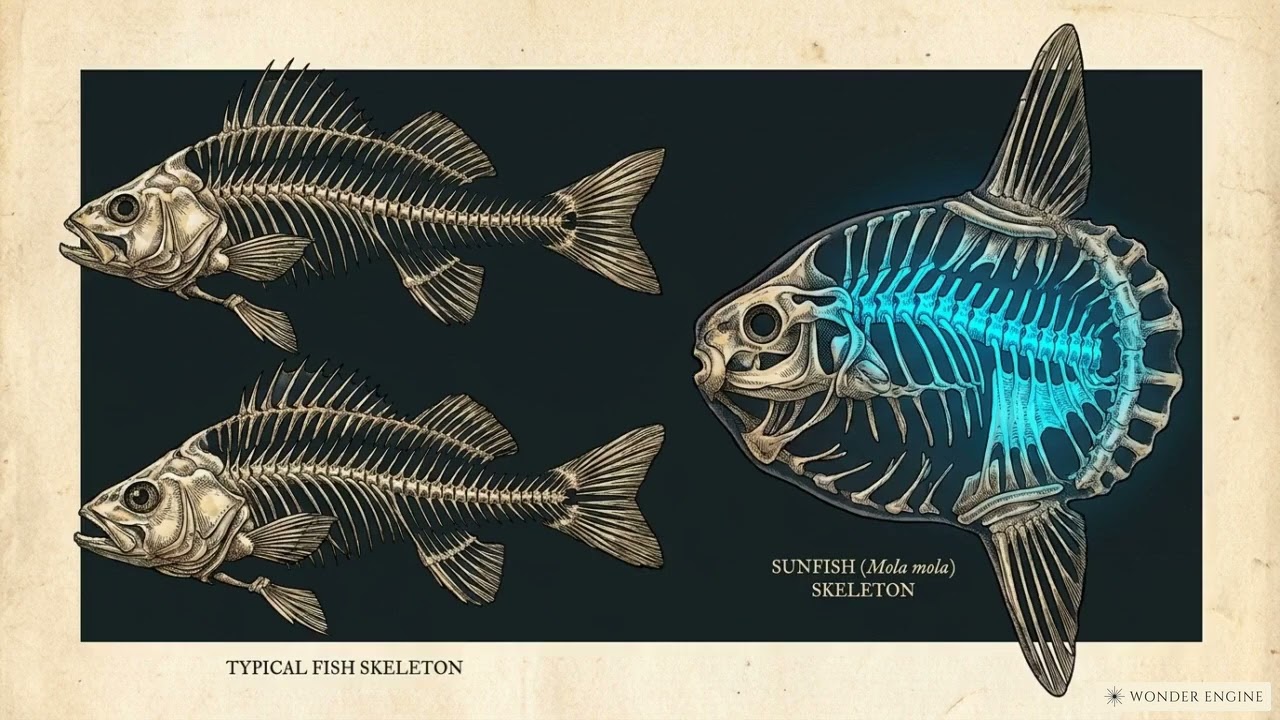
The Ocean Sunfish Releases 300 Million Eggs and Still Loses Ground
A single Mola mola female carries up to 300 million eggs, the highest fecundity in any vertebrate, yet the species is now listed as Vulnerable.

Why the Aye-Aye Taps Trees Eight Times a Second
The aye-aye survived being declared extinct in 1933. Today it is killed on sight in Madagascar for the very finger that keeps it alive.