
← Wonder EngineWonder no. 20Stranger beasts6min read
Why a 500-Million-Year-Old Worm Fires Whipping Glue Jets From Its Face at 60 Hz
The story behind the wonder.
A soft, nearly blind rainforest hunter fires two whipping jets of glue at 30 to 60 hertz, and has done so since before there were forests.
Published
UTC
Reading time
6 min
~210 wpm
Word count
1,256
plain English
Category
Stranger beasts
stranger-beasts
On a wet rainforest floor, a soft, palm-length animal raises two fleshy nozzles either side of its mouth and fires twin jets of liquid glue that oscillate at 30 to 60 hertz, and it has been hunting this way since before there were trees.
A weapon fired from the face
The velvet worm does something that no other animal on Earth is known to do. From a pair of oral papillae either side of its mouth, it ejects two simultaneous jets of liquid slime. According to Andrés Concha and colleagues, writing in Nature Communications in 2015, those jets leave the body at 3 to 5 metres per second and oscillate from side to side at 30 to 60 hertz. The opening of each papilla is only 50 to 200 microns wide. As the liquid is propelled clear of the worm, it stretches into threads roughly 20 microns in diameter, and within seconds of contact with the air those threads harden into a sticky net that glues the prey to the substrate.
The chemistry behind that net is unusual. The slime is about 90 percent water. The dry residue is dominated by collagen-type proteins and 1.3 percent sugars, primarily galactosamine. It also contains a surfactant called nonylphenol. As the marine chemical ecologist Karina Benkendorff summarised in her 1999 analysis, "Onychophora are the only organisms known to produce" that compound, a substance never detected in any other animal slime.
The whipping motion is not decorative. The worm is nearly blind, with no eyes capable of forming sharp images, and it cannot precisely aim. The 30 to 60 hertz oscillation of the papillae sweeps a wide net over the strike zone, and that net is what catches the cricket, the woodlouse, or the spider. Most strikes land at an effective range of about 1 centimetre. The longest measured range on record is approximately 10 centimetres.
A patient hunter under bark
The hunters that fire these jets belong to the phylum Onychophora, a small and ancient group with roughly 232 living species described as of 2023. They are split between two families, Peripatidae and Peripatopsidae, and their soft segmented bodies are covered in tiny papillae that give the cuticle its dry-to-the-touch, velvety sheen. Adults range from about 0.1 centimetres in the diminutive Ooperipatellus nanus to 22 centimetres in Mongeperipatus solorzanoi, a 220-fold span within a single phylum. The number of leg pairs is not fixed either: it ranges from 13 in the smallest species to 43 in Plicatoperipatus jamaicensis.
They live in moist tropical and temperate rainforests across an oddly scattered map: South America, Central America, the Caribbean, Gabon, Northeast India, Southeast Asia, Chile, southern Africa, Australia, New Zealand and New Guinea. They hide under bark and rotting leaf litter, retreat from bright light during the day, and emerge to hunt only at night. To find prey in the dark, they rely on a pair of long antennae and a row of mechanosensitive papillae. Their feet end in small claws built from three stacked elements "like Russian nesting dolls", as the comparative-morphology literature describes them, with the outermost element shed at every moult, roughly every fourteen days.
Hunting is solitary in most species, but not all. In Australia, members of the genus Euperipatoides live in groups of up to 15 individuals in a single log, with a dominant female that always feeds first on captured prey. Targets are usually arthropods around two-fifths the size of the worm, which is a striking ratio for an animal without sharp vision or hardened armour.
The cost of homemade glue
The reason velvet worms can hunt this way at all, and the reason they cannot do it often, is metabolic. The slime is expensive. It can account for up to 11 percent of the animal's total dry body weight, a figure reported by Read in 1987. To avoid losing all of that invested protein with every meal, the worm chews and swallows the hardened threads along with the prey. Because of this recycling, about 90 percent of the time spent eating is dedicated to ingesting the slime and prey together rather than handling the carcass.
Even with recycling, a full discharge is a significant biological event. After exhausting its slime reservoir, a velvet worm requires about 24 days to fully replenish its stores. That single number constrains the entire rhythm of the animal's life. Velvet worms eat only once every one to four weeks. Most of their existence is not hunting but waiting, hidden in the damp, conserving the next jet.
That trade-off, frequent activity surrendered for high-certainty ambushes, is the bargain the lineage struck a long time ago. And it has been keeping the bargain for a very long time.
A body plan older than trees
The two modern families of velvet worms diverged roughly 274 million years ago, in the late Paleozoic. But the body plan goes back further still. Onychophoran-like stem-group fossils appear in Cambrian deposits more than 500 million years old. The oldest confirmed crown-group velvet worm fossil, Antennipatus, is preserved in Late Carboniferous rocks. A second, Cretoperipatus, comes from the Late Cretaceous.
To put that timeline in plain terms: this lineage is older than wings, older than flowering plants, and older than the first tetrapods to walk on land. The strategy of ambushing arthropods at night with whipping jets of homemade glue was working in the Cambrian, and it has not been replaced. The fundamental body plan remains recognisable across every species alive today.
The reproductive biology has aged just as oddly. Most velvet worms are viviparous. Embryos develop inside the mother for between 6 and 17 months, and a single female produces between 1 and 23 live young per year. A single gestation can last up to 15 months, longer than a human pregnancy, inside an animal that often weighs less than a gram. At least one species, Epiperipatus imthurni in Trinidad, dispenses with males entirely: none have ever been found, and the females reproduce by parthenogenesis, cloning themselves. The genome of a related species, Epiperipatus broadwayi, has been sequenced at roughly 5.60 gigabase pairs, of which about 70.92 percent is repetitive sequence.
A strategy that refused to be replaced
There is a temptation to call something this old primitive. The velvet worm complicates that word. A soft, slow, nearly blind animal, weighing less than a gram, has been making a chemically distinctive surfactant that no other animal on Earth produces, firing it through 50 to 200 micron nozzles at 3 to 5 metres per second, sweeping a 30 to 60 hertz net across whatever moves nearby, recycling 11 percent of its dry body weight back into its gut after each hunt, and gestating its young for up to 15 months inside a body the size of a finger joint. It has been doing all of that, more or less unchanged, for over half a billion years.
The wonder is not that the velvet worm has survived. It is that the Cambrian solution has not needed an upgrade. On a wet rainforest night, somewhere under a fallen log in Gabon or Trinidad or New South Wales, the slime is being mixed, the papillae are being aimed by touch and antennal sweep, and the next ambush is being staged exactly as it was when the first stem-group onychophorans were hunting in shallow seas. The strategy was effective then. It is effective now.
Sources
// Sources · primary references
03 refs- Wikipedia: Onychophoraen.wikipedia.org
- Concha et al., Nature Communications, 2015nature.com
- Benkendorff et al., 1999onlinelibrary.wiley.com
// More from Stranger beasts
See category →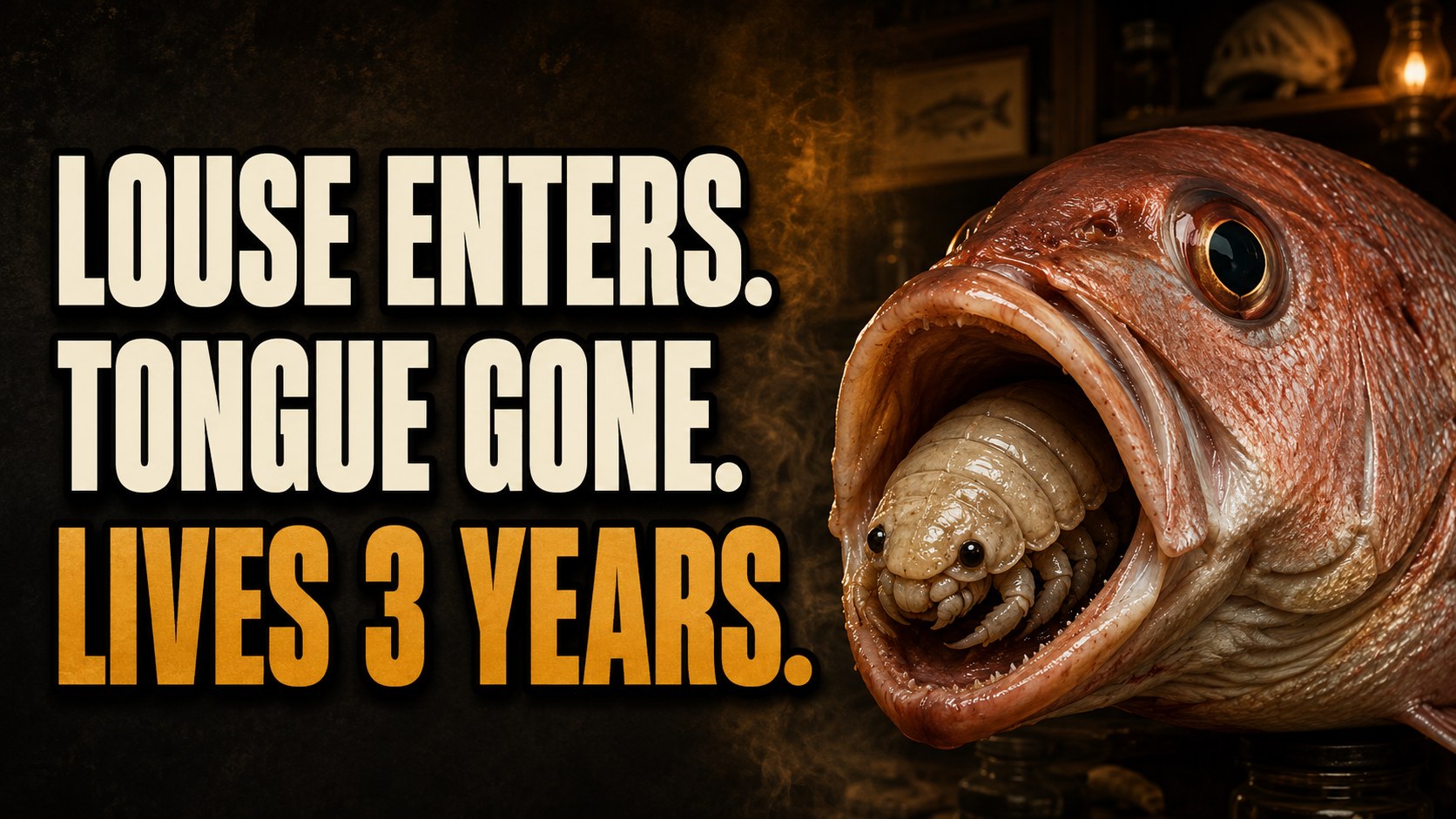
The Parasite That Replaces a Fish's Tongue: Cymothoa exigua
A small isopod off Costa Rica severs a snapper's tongue, waits for the tissue to die, and clamps itself into the socket for up to three years.
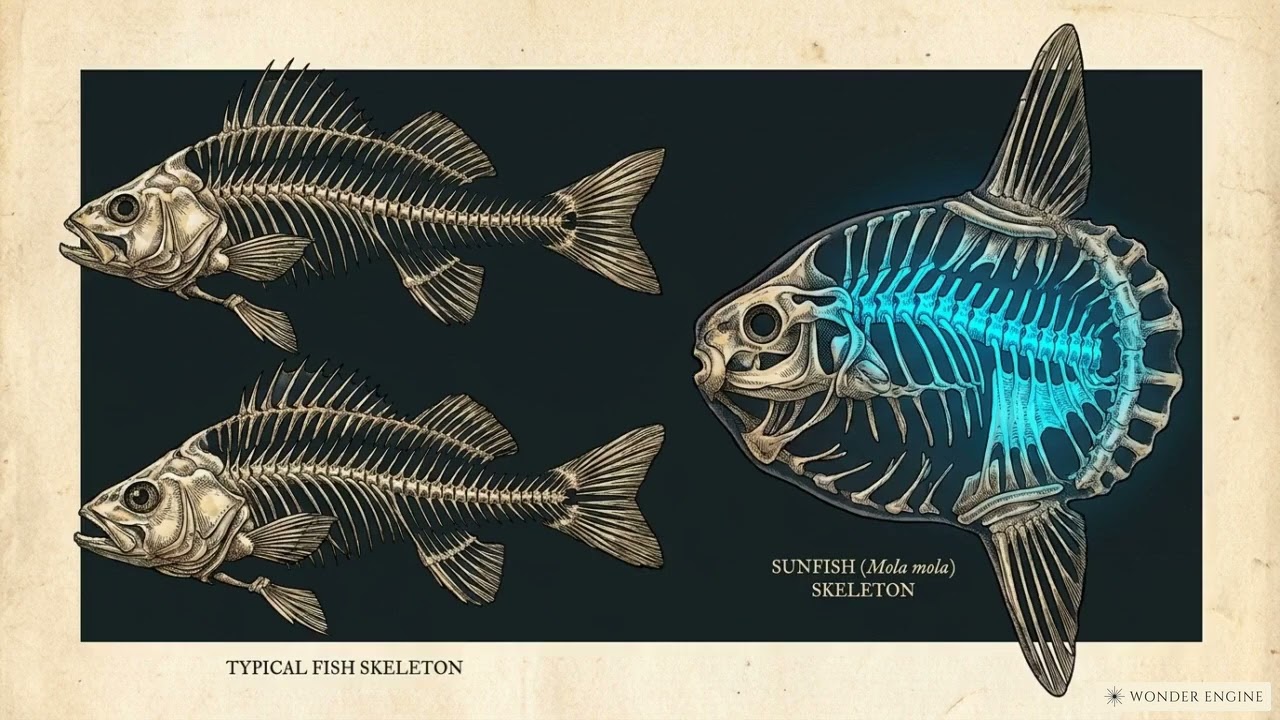
The Ocean Sunfish Releases 300 Million Eggs and Still Loses Ground
A single Mola mola female carries up to 300 million eggs, the highest fecundity in any vertebrate, yet the species is now listed as Vulnerable.

Why the Aye-Aye Taps Trees Eight Times a Second
The aye-aye survived being declared extinct in 1933. Today it is killed on sight in Madagascar for the very finger that keeps it alive.