
← Wonder EngineWonder no. 11Stranger beasts6min read
Why a Bombardier Beetle Fires Boiling Acid at 500 Pulses per Second
The story behind the wonder.
A fingernail-sized beetle brews a near-boiling chemical jet inside its own body and survives it, roughly five hundred times a second.
Published
UTC
Reading time
6 min
~210 wpm
Word count
1,270
plain English
Category
Stranger beasts
stranger-beasts
A beetle the size of a fingernail brews a near-boiling chemical reaction inside its own abdomen and survives it, roughly five hundred times a second.
The observation
The bombardier beetle defends itself by firing a hot, noxious chemical spray from the tip of its abdomen, and the discharge exits at a temperature very close to the boiling point of water, near 100 degrees Celsius. The jet is not a continuous stream. It leaves the body as a sequence of extremely fast micro-pulses that sound like an audible pop, firing roughly 500 times per second. Each individual discharge sequence consists of about 70 distinct pulses. The reaction generates enough heat to vaporize roughly one-fifth of the discharged liquid into steam before it ever reaches the predator.
Stated together, those numbers describe something most people have never asked an insect to do. A creature you could lose in the seam of a glove routinely generates, and survives, a high-pressure explosion inside its own body. The pressure is real. The heat is real. The chemistry is real. And the beetle keeps walking afterward.
A single individual can fire roughly twenty discharge sequences in rapid succession before its reservoirs run low. It aims with a swivelling abdominal tip; in some African species the tip rotates through up to 270 degrees with considerable accuracy. The weapon is not a stunt or a one-time sacrifice. It is the everyday business end of an animal that hunts at night and rests in dense groups during the day.
Where it lives, and how many species
This is not a single curiosity from a single jungle. The thermal weapon is shared by a large and successful family. There are more than 500 described species of bombardier beetle known worldwide, distributed across the two subfamilies Brachininae and Paussinae within the ground beetle family Carabidae. They live on every continent except Antarctica, with their primary habitats in the woodlands and grasslands of the temperate zones. Most are nocturnal carnivores; they hunt other insects at night and often congregate in dense groups during the day.
The variation across the family also matters for understanding the mechanism's history. The species Metrius contractus, a basal member of Paussinae, produces a much weaker foaming discharge rather than a pulsed jet, a structural precursor that supports the gradual evolutionary origin of the full mechanism. The quinone chemistry the beetle exploits for defense is also a precursor to sclerotin, the molecule that hardens insect cuticle, which is part of why the same family of reactions appears across many beetle lineages. The bombardier beetle did not assemble its weapon from nothing. It tuned reactions its relatives already carried.
Two chambers, one explosion
The mechanism is built around a refusal to mix. The beetle stores defensive chemicals in two specialized abdominal glands, holding the reactants separately so they cannot react until summoned. One gland holds an aqueous solution of hydroquinones. The other holds hydrogen peroxide. While the beetle is calm, these solutions sit inert, in separate rooms.
When the beetle is attacked, it mixes the hydroquinones and the hydrogen peroxide with the enzymes catalase and peroxidase inside a reinforced reaction chamber. The enzyme-catalyzed reaction is strongly exothermic and oxidizes hydroquinones into 1,4-benzoquinone, the main irritant in the spray. The same reaction releases oxygen gas, water vapor, and enough heat to vaporize roughly one-fifth of the discharged liquid. Heat, irritant, and propellant are all generated at the moment of need, in a chamber that was empty a fraction of a second earlier.
This precise anatomical choreography lets the animal hold inert chemicals safely, then generate the dangerous ones only at the instant of attack. There is no warehoused poison waiting to leak. There is only the architecture of separation and the readiness to combine.
What the synchrotron finally saw
For a long time, biologists could hear the discharge but could not see inside it. The pulsed spray was first described 25 years before the 2015 imaging study by a Cornell and MIT collaboration that recorded its external acoustics but could not see inside the beetle. Christine Ortiz of MIT, senior author of the 2015 Science paper, put the gap plainly: "For decades, the complex mechanism of how the bombardier beetle achieves spray pulsation as a chemical defense has not been understood, because only external observations were used previously."
In 2015, a team led by graduate student Eric Arndt and Ortiz at MIT, with Wendy Moore at the University of Arizona, finally looked inside the living insect. The study used high-speed synchrotron X-ray imaging at the Advanced Photon Source at Argonne National Laboratory to film the discharge from inside the living beetle for the first time. Filming at 2,000 X-ray frames per second, the team captured 30 discharges from 14 individual beetles of the species Brachinus elongatulus, collected from riparian habitats in southern Arizona. Decoding the physics of a one-centimeter beetle required mobilizing one of the most advanced particle acceleration facilities on Earth.
The X-rays revealed that the spray jet is shaped by a thin, flexible membrane on the wall of the reaction chamber that acts as a passive valve. Each explosion expands the membrane and pinches off the supply of fresh reactants. Once internal pressure drops, the membrane relaxes, and the next pulse arrives a fraction of a millisecond later. The reaction chamber wall is built from beetle cuticle, a composite of chitin, proteins, and waxes, stiff over most of its surface but locally flexible at the membrane region. The expansion membrane geometry differs between male and female Brachinus elongatulus, a sexual dimorphism that had not been documented before the 2015 imaging study.
The pulsing mechanism is entirely passive. The beetle does not actively open and close a valve; the pressure does it for them. Arndt put the survival logic in physical terms: "Both the speed and the heat serve to make the spray even more effective against potential predators. The pulsing nature of the spray may help protect the structure of the beetle's reaction chamber, allowing time for the chamber walls to cool a bit before the next pulse." Moore was direct about what the imaging actually showed: "It turns out the expansion membrane of the reaction chamber acts as a passive closure mechanism, which is something that had not been described or even predicted before this study." The 2015 study also confirmed that the spray of Brachinus elongatulus is propelled roughly five times faster than benzoquinone defensive sprays in other insects that do not use the pulsing mechanism.
The paradox
A passive pressure-actuated valve, cycling hundreds of times per second, cooling its own walls between explosions, made of chitin and protein and wax. Nature arrived at that design without drafting it. Human engineers are still learning to draft things like it. Moore framed the technological reading carefully: "Understanding how these beetles produce, and survive, repetitive explosions could provide new design principles for technologies such as blast mitigation and propulsion."
The beetle, of course, is not aware of any of this. It hunts other insects at night, rests during the day, and reacts when something larger comes too close. The fluid dynamics it executes are not a thought. They are a structure, shaped over deep time, that happens to solve a problem human engineers find hard. The wonder is not that an insect can burn an ant. It is that an insect carries a working pulsed combustion engine and survives every time it pulls the trigger.
Sources
// Sources · primary references
03 refs- Wikipedia, Bombardier beetleen.wikipedia.org
- Arndt, Ortiz, Moore et al., Science 348 (2015)science.org
- ScienceDaily summary of Arndt et al., 2015sciencedaily.com
// More from Stranger beasts
See category →
The Parasite That Replaces a Fish's Tongue: Cymothoa exigua
A small isopod off Costa Rica severs a snapper's tongue, waits for the tissue to die, and clamps itself into the socket for up to three years.
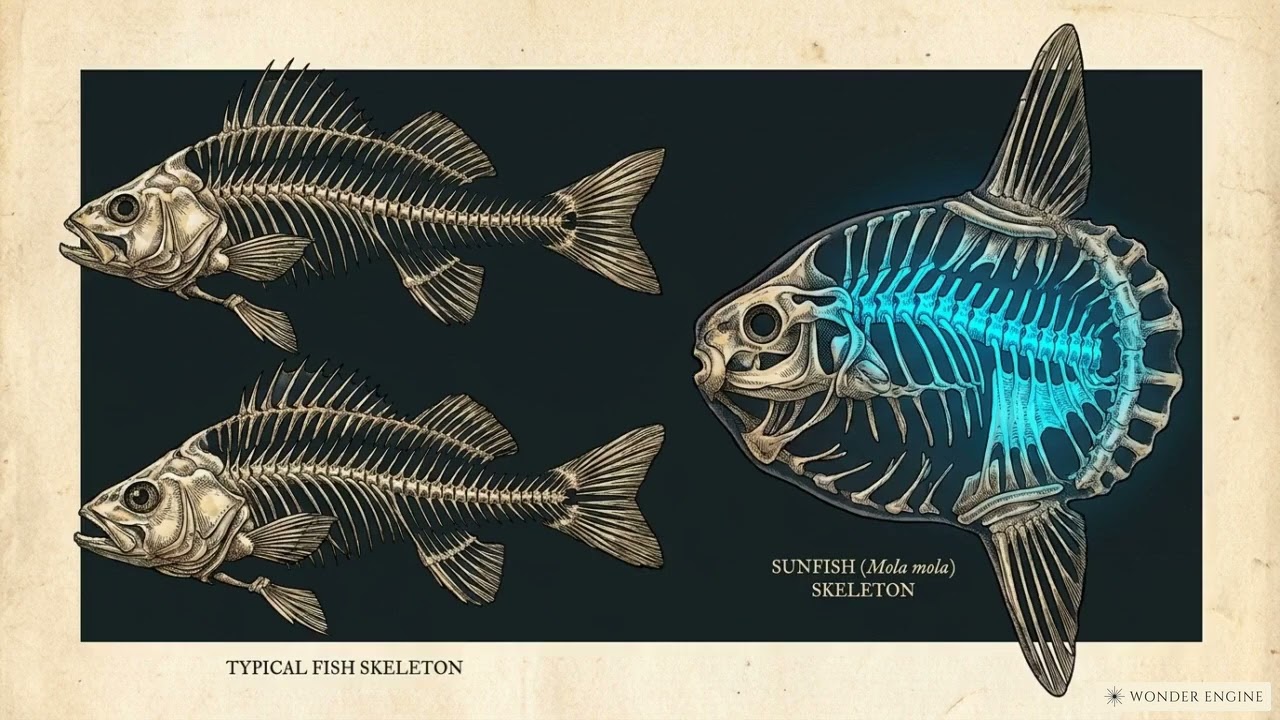
The Ocean Sunfish Releases 300 Million Eggs and Still Loses Ground
A single Mola mola female carries up to 300 million eggs, the highest fecundity in any vertebrate, yet the species is now listed as Vulnerable.

Why the Aye-Aye Taps Trees Eight Times a Second
The aye-aye survived being declared extinct in 1933. Today it is killed on sight in Madagascar for the very finger that keeps it alive.