
← Wonder EngineWonder no. 16Stranger beasts6min read
Why a Hagfish Drowns Sharks With Slime That Expands 10,000× in 0.4 Seconds
The story behind the wonder.
A jawless, eyeless fish older than dinosaurs defeats sharks with a secretion that inflates ten thousand times in four tenths of a second.
Published
UTC
Reading time
6 min
~210 wpm
Word count
1,245
plain English
Category
Stranger beasts
stranger-beasts
An animal older than dinosaurs, with no jaw, no spine in the usual sense, and no functioning eyes, routinely defeats sharks by suffocating them in a secretion that inflates ten thousand times its starting volume in four tenths of a second.
A defence measured in milliseconds
When the secretion of a hagfish makes contact with seawater, it expands to 10,000 times its starting volume in 0.4 seconds. That single sentence captures the entire encounter between a hagfish and a predator that has made the mistake of biting it. The animal producing the expansion is a marine, jawless, eel-shaped fish. It possesses a skull but no true vertebral column, relying instead on rudimentary vertebrae and a flexible cartilaginous notochord. It has no visible eyes. What it has are simple eyespots, described in the literature as "a regressed form of a more complex, basal vertebrate eye." Those spots lack lenses and cannot resolve detailed images.
The chemistry behind the expansion is more interesting than the size of it. Hagfish slime is viscoelastic, meaning its behaviour shifts under different applied forces. Under elongational flow, the kind of stretching motion produced by a predator inhaling water across its gills, viscosity increases sharply and the slime clogs the gills. Under shear, the sliding force the hagfish itself applies as it scrapes free, viscosity decreases. The same fluid that drowns a shark slips off the fish that produced it. The attack and the escape route are the same substance, behaving in opposite ways depending on how it is being deformed.
Life on the cold seafloor
The Pacific hagfish inhabits the seafloor from southeast Alaska south to Baja California, Mexico, at depths from 16 to 966 metres. A 2015 record off Costa Rica extended the species' known southern range by approximately 3,500 kilometres. Mature individuals typically reach about 42 centimetres, with a documented maximum body length of 63 centimetres. The largest known hagfish species, Eptatretus goliath, has been measured at 127 centimetres. The smallest documented individuals are only 4 centimetres long. William Lockington described the Pacific hagfish in 1878; long before that, Carl Linnaeus had misclassified the animal as an "intestinal worm."
The biology of the species is shaped by an exceptionally austere food supply. Pacific hagfish are scavengers. They enter dead and dying animals through the mouth or anus and consume the carcass from the inside out. Stomach content analyses have turned up polychaete worms, shrimp, hermit crabs, cephalopods, brittle stars, bony fishes, sharks, birds, and whale flesh. To operate inside oxygen-depleted bodies, they maintain what Wikipedia describes as an "incredibly low metabolic rate, regarded as the lowest among fishes." Their skin can also absorb amino acids directly from the surrounding water, an unusual feeding pathway for a vertebrate. Every feature of the animal, from the chemistry of its skin to the throttle on its metabolism, is tuned to a habitat where calories are rare and competition for carcasses is fast.
One hundred glands and a coiled thread
The slime is not a uniform gel. When grabbed or attacked, a hagfish ejects its slime from roughly 100 specialised glands running along each flank of its body. Each discharge releases mucin vesicles and skeins of coiled thread cells made of keratin-like intermediate filaments. A single unspooled thread cell measures roughly 15 centimetres in length and only 1 to 3 micrometres in width. When the mixture hits seawater, the mucin vesicles burst, the skeins unfurl, and the entire secretion inflates by a factor of ten thousand in less than half a second.
Lim and colleagues, publishing in the Nature journal Scientific Reports in 2016, tested the gill-clogging hypothesis experimentally and confirmed that hagfish slime acts as a physical defence by clogging predator gills. The threads and mucin form a mechanical barrier across the gill filaments and disable respiration. The predator releases the fish; the fish, still alive, is now coated in a substance that should by every reasonable measure have trapped it as well.
It escapes by tying itself into a knot. Specifically, the hagfish forms an overhand knot in its own body and slides the knot from head to tail, scraping the secretion off as it goes. Pacific hagfish form overhand, figure-eight, and higher-order knots, a flexibility enabled by the absence of a rigid vertebral column. Eptatretus hagfish are documented using knotting behaviour more frequently than sea snakes and moray eels. The animal can squeeze through openings less than one-half of its total body width, partly because roughly one-third of its blood volume is stored in a subcutaneous sinus between skin and muscle. Hagfish carry roughly twice the blood volume per body mass of comparable mammals. After a complete slime discharge, the Pacific hagfish takes about 24 to 28 days to fully regenerate its glands.
An ancient lineage, a modern highway
The lineage is old. The oldest known stem-group hagfish fossils are from the Late Carboniferous, approximately 310 million years ago. Modern hagfish representatives first appear in the fossil record around 100 million years ago, in the mid-Cretaceous. Hagfish and lampreys form the superclass Cyclostomi, and genetic evidence shows they are more closely related to each other than to any jawed vertebrate. The body plan predates jaws, predates true vertebrae, predates the visual apparatus that almost every fish in the surrounding water relies on.
Most people who have heard of hagfish at all heard of them on a single day. On 13 July 2017, a truck on U.S. Highway 101 in Oregon, carrying about 7,500 pounds (3,400 kilograms) of live hagfish bound for South Korean food markets, overturned and released so much slime onto the road and a passing car that emergency crews had to close the highway and bulldoze the substance away. Wikipedia records the incident in flat language: "When in 2017 a road accident on U.S. Highway 101 resulted in 7,500 pounds (3,400 kg) of hagfish being spilled, they emitted sufficient slime to cover the road and a nearby car." It was a macroscopic demonstration of an animal defence that had been refined in the deep sea for hundreds of millions of years, deposited on asphalt by a logistical accident.
A 310-million-year-old material under a microscope
The threads themselves are now under study as a material. Douglas Fudge, at Chapman University, leads research aimed at developing hagfish slime threads into biodegradable, ultra-strong fibres for protective clothing. The strength relies on a molecular transition. Within the threads, two keratin proteins, EsTKα and EsTKγ, shift from α-helical structures into stiffer β-sheet structures when the fibre is stretched. After draw-processing and chemical cross-linking, the recombinant hagfish thread protein has been measured at an elastic modulus of 20 gigapascals, placing it inside the range of high-performance synthetic fibres.
That is the paradox the fact pack flags, and it is worth ending on. The hagfish is one of the oldest surviving vertebrates on Earth. It lacks jaws. It lacks a true vertebral column. Its eyes are eyespots without lenses, sitting under a transparent window in the skin and visible from outside as a white spot. By any quick reading of evolutionary progress it should have been replaced long ago. Instead, in the chemistry and timing of its single anatomical trick, it sits ahead of human materials science. The animal is not primitive; it is ancient, and its solutions are not crude.
Sources
// Sources · primary references
04 refs- Wikipedia: Hagfishen.wikipedia.org
- Wikipedia: Hagfish slimeen.wikipedia.org
- Wikipedia: Pacific hagfishen.wikipedia.org
- Lim et al., Scientific Reports (2016)nature.com
// More from Stranger beasts
See category →
The Parasite That Replaces a Fish's Tongue: Cymothoa exigua
A small isopod off Costa Rica severs a snapper's tongue, waits for the tissue to die, and clamps itself into the socket for up to three years.
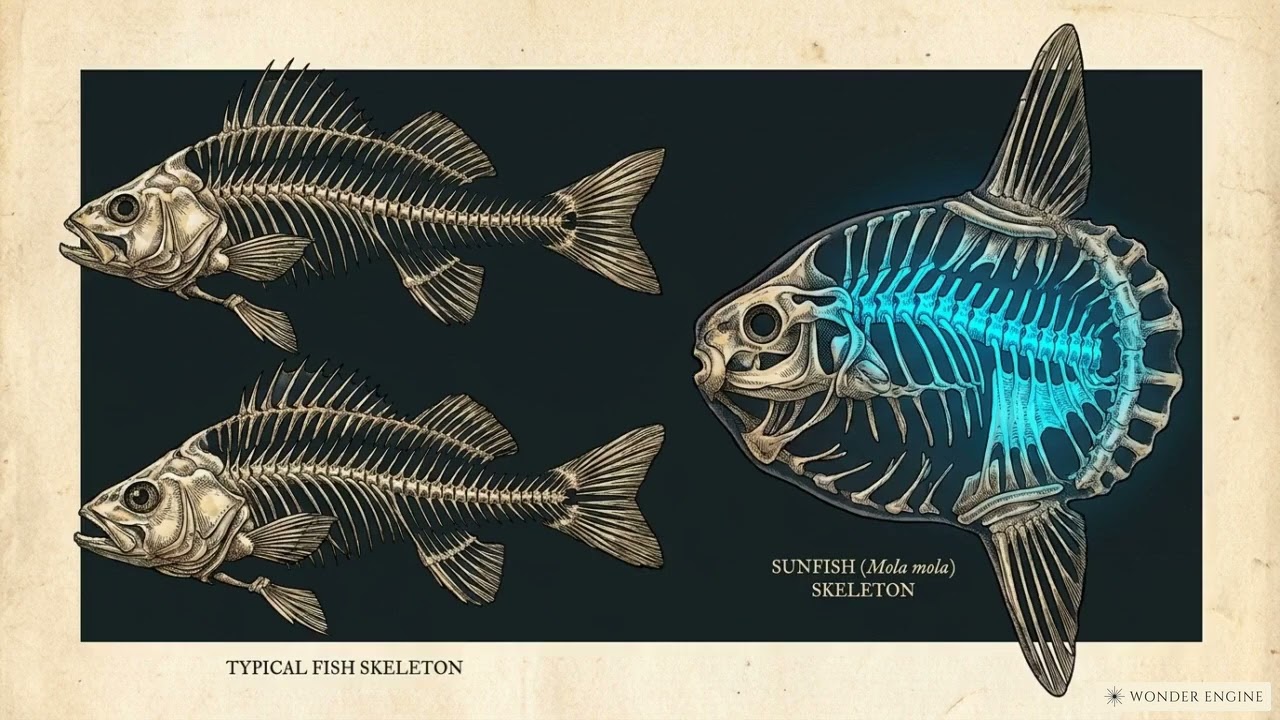
The Ocean Sunfish Releases 300 Million Eggs and Still Loses Ground
A single Mola mola female carries up to 300 million eggs, the highest fecundity in any vertebrate, yet the species is now listed as Vulnerable.

Why the Aye-Aye Taps Trees Eight Times a Second
The aye-aye survived being declared extinct in 1933. Today it is killed on sight in Madagascar for the very finger that keeps it alive.