
← Wonder EngineWonder no. 17Stranger beasts6min read
Why a Sea Cucumber Vomits Its Own Internal Organs, Then Regrows Them in 5 Weeks
The story behind the wonder.
A soft, slow invertebrate defends itself by expelling its own organs, then rebuilds them in weeks. The biology behind the trade.
Published
UTC
Reading time
6 min
~210 wpm
Word count
1,265
plain English
Category
Stranger beasts
stranger-beasts
When a sea cucumber of the family Holothuriidae is touched by a predator, it pushes water from its respiratory tree into a bundle of sticky white threads and fires them out through its anus, where they elongate up to twenty times their original length within seconds and obtain a firm grip on the attacker in under ten seconds.
A defense fired from the inside out
The threads have a name and a history. They are Cuvierian tubules, after the French zoologist Georges Cuvier, who first described them in 1831 in his work The Animal Kingdom Arranged in Conformity with Its Organization. In the resting animal they sit at the base of the respiratory tree, several hundred of them in a single individual, lying freely in the coelomic fluid and waiting on a signal that may never come. When it does, the mechanism is hydraulic. As Wikipedia's entry on the tubules puts it plainly, "Water from the respiratory tree is forced into these tubules causing a rapid expansion." A tangle that fit inside an animal a few centimetres wide unfurls into a net several times the predator's own size, sticky on contact, and, in the words of the same source, "A firm grip is obtained in under ten seconds."
The entanglement works on two channels at once. Physically, the tubules wrap and immobilise small attackers like crustaceans and the occasional fish. Chemically, they carry holothurin, a toxic saponin with soap-like surfactant properties that kills small marine animals caught in the threads. The combination is enough to turn a creature with no shell, no spines, and almost no muscle for swimming into a problem that a passing crab is well advised to leave alone.
The cost is real. The tubules are gone after they fire. So in a wider set of holothurians, is the entire respiratory tree and digestive tract, which certain sea cucumbers expel through the cloaca in an autotomic process called evisceration. The animal is not throwing a weapon. It is throwing itself, in pieces, and walking the answer back later.
The clock that follows
What makes the defense work as a strategy and not as a suicide is the timing of the rebuild. After expulsion, Cuvierian tubules regenerate in approximately seventeen days in Holothuria leucospilota, and in around five weeks in Holothuria forskali. For species that fully eviscerate the gut and respiratory tree, replacement of those lost organs takes one and a half to five weeks depending on species. The animal trades its viscera for time, and the trade clears.
It is worth sitting with that interval. A vertebrate that loses its respiratory tract is dead within minutes. A holothurian that loses its respiratory tree is, on the slowest end, inconvenienced for thirty-five days. On the seafloor, where the animal can stop moving and wait, that interval is not the catastrophe it would be in a faster body. It is a recovery window.
There is no decision in any of this. The narration that goes with the source is careful on that point: the animal reacts. The mechanism fires when it is triggered, the organs grow back when they grow back, and the species that survive are the ones whose timetable, on average, beats the predator's. The math of the trade is the biology of the trade.
A body plan built for everywhere
The reason this defense has lasted is that the body plan around it has lasted. The oldest known sea cucumber fossils come from the middle Ordovician, more than 450 million years ago. The continuous fossil record places this anatomy on Earth across multiple mass extinctions and into the present without an obvious break. Humanity, by any honest accounting, is a late observer.
The animal's range underscores the point. A typical sea cucumber runs ten to thirty centimetres in body length, though the species Synapta maculata reaches more than three metres. There are roughly 1,786 known living species, the greatest number of which sit in the Asia-Pacific region. They occupy coral shallows, sediment flats, kelp understorey, and, most strikingly, the deep ocean. Below 8,900 metres, sea cucumbers account for around ninety percent of total macrofauna biomass. Some Myriotrochus species have been recovered at 10,687 metres, well into the hadal zone, in absolute darkness and under pressures that crush almost everything else with a body.
Density tells the other half of the story. In dense South Pacific populations, sea cucumbers at forty individuals per square metre process about nineteen kilograms of sediment per square metre per year. The strawberry sea cucumber Squamocnus brevidentis, off New Zealand, reaches densities of up to a thousand individuals per square metre. A single specimen can swallow more than forty-five kilograms of sediment per year while feeding. Multiplied across a bed, the floor of the ocean is, in effect, being run through these animals.
The long human record, and a market that broke it
Humans noticed the sea cucumber early. An earlier Greek reference to a form of the word appears in the poet Epicharmus around 450 BC. Aristotle later coined the term holothurion in his Historia animalium. Centuries on, Cuvier described the tubules in 1831, and the French naturalist Henri-Marie Ducrotay de Blainville formally described the subclass Holothuroidea in 1834. In Japan's Noto Peninsula, local sea cucumber harvest is reported to date back to the eighth century. In Australia's late-1800s fishery, as many as four hundred divers from Cook Town, Queensland, worked the trade in a single season.
The modern record is the harder reading. Dried sea cucumber, known as bêche-de-mer or trepang, is a high-value seafood across China, Japan, Korea, Indonesia, and the Pacific islands. In 2016, listings on Alibaba reached up to one thousand US dollars per kilogram. The pressure that price exerts on wild populations is what eventually showed up in policy. India banned commercial sea cucumber harvest in 2001 under Schedule I of its Wild Life (Protection) Act, and in 2020 declared the Dr. K. K. Mohammed Koya Sea Cucumber Conservation Reserve, the world's first dedicated sanctuary of its kind.
The smaller curiosities sit alongside the larger ones. Pearl fish, small eel-like fish, live inside the cloaca of some sea cucumbers, entering and exiting through the anus, and members of genus Actinopyga have evolved anal teeth as a defense against this. The animal that throws its respiratory tree at a crab also, in some species, keeps a guarded back door against an uninvited tenant.
The paradox that holds
A holothurian is one of the softest and slowest things in the ocean. It has no skeleton in the conventional sense, no fast escape, no obvious armament other than the threads it can fire once and then regrow. By the standards of the predator literature, it should not have survived. It is, by the standards of the fossil record, one of the longest-surviving body plans on Earth, present since the middle Ordovician, before fish had crawled onto land and long before mammals existed in any form.
The same animal, dried, has sold for up to a thousand US dollars per kilogram. One of the slowest invertebrates in the ocean is, in the eyes of an East Asian wholesale market, worth more than silver by weight. That contradiction, soft and ancient and sold by the gram, is the shape of the whole story. The defense works because the timetable works. The timetable works because the body plan works. The body plan worked for four hundred and fifty million years, and has finally encountered a predator it cannot outwait.
Sources
// Sources · primary references
02 refs- Wikipedia, Sea cucumberen.wikipedia.org
- Wikipedia, Cuvierian tubulesen.wikipedia.org
// More from Stranger beasts
See category →
The Parasite That Replaces a Fish's Tongue: Cymothoa exigua
A small isopod off Costa Rica severs a snapper's tongue, waits for the tissue to die, and clamps itself into the socket for up to three years.
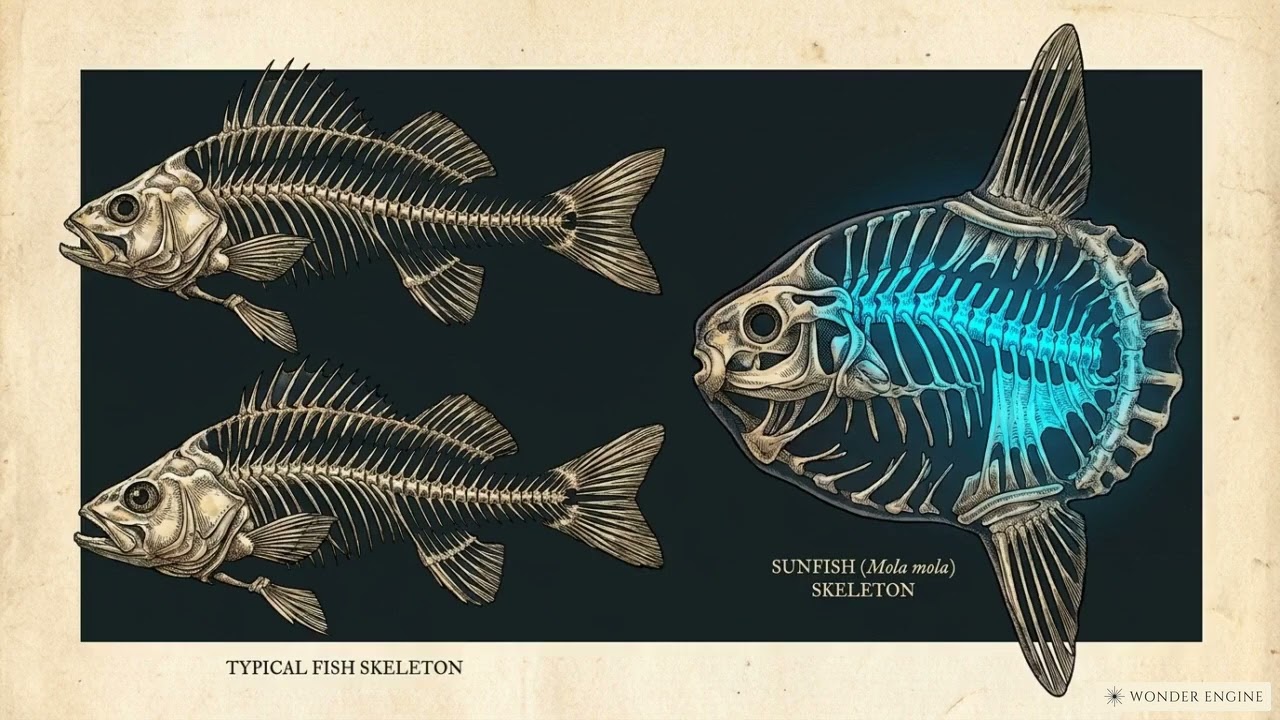
The Ocean Sunfish Releases 300 Million Eggs and Still Loses Ground
A single Mola mola female carries up to 300 million eggs, the highest fecundity in any vertebrate, yet the species is now listed as Vulnerable.
Why the Aye-Aye Taps Trees Eight Times a Second
The aye-aye survived being declared extinct in 1933. Today it is killed on sight in Madagascar for the very finger that keeps it alive.