
← Wonder EngineWonder no. 12Stranger beasts6min read
Why a Colour-Blind Octopus Impersonates 18 Different Marine Species On Command
The story behind the wonder.
A soft-bodied cephalopod in Indo-Pacific estuaries impersonates at least 18 species, picking its disguise based on whichever predator just turned up.
Published
UTC
Reading time
6 min
~210 wpm
Word count
1,350
plain English
Category
Stranger beasts
stranger-beasts
In a single five-day observation in 2008, one mimic octopus was filmed pretending to be a flatfish more than 500 times, and the strangest part of that statistic is that the animal performing it cannot see in colour.
An estuary with nowhere to hide
The mimic octopus, Thaumoctopus mimicus, lives in a habitat that should not, on paper, support a small soft-bodied cephalopod at all. Its range stretches across the tropical Indo-Pacific, from the Red Sea and Gulf of Oman in the west to New Caledonia in the east, and from the Gulf of Thailand and the Philippines in the north to the Great Barrier Reef in the south. Within that range it sticks to a narrow niche: shallow sand and silt habitats less than 15 metres deep, the river mouths and estuaries where rivers offload sediment into warm coastal water.
These are not the postcard reefs that most cephalopod footage comes from. There is no complex coral architecture to disappear into, no anemone garden, no rubble field. The water is heavily silted, the seabed is open, and the bottom is plain enough that an animal sitting on it has nowhere obvious to go. The mimic octopus's natural colour is a plain light brown to beige, which makes it visible on open sand rather than hidden by it. The high-contrast striped white-and-brown banding that most people associate with the species is not a resting state. It is a defensive display, switched on for an audience.
That is the engineering problem the animal solves. Without coral cover, traditional camouflage cannot work. The only shelter on offer in a featureless estuary is behavioural: convince whatever is hunting you that you are the wrong thing to attack.
A defenceless body, dressed as dangerous neighbours
The strategy has a name in the literature. As Wikipedia's article on Mimicry puts it, "Octopuses of the genus Thaumoctopus (the mimic octopus) are able to intentionally alter their body shape and coloration to resemble dangerous sea snakes or lionfish." This is Batesian mimicry, in which a defenceless animal evolves to resemble a dangerous one in order to avoid being eaten. The mimic octopus has taken that template and built an entire repertoire out of it.
Direct observation has confirmed the mimic octopus impersonating at least 18 different marine species across its range. The documented list includes the banded sea snake, the lionfish, jellyfish, the zebra sole, generic flatfish, small sponges, tube worm tubes, and colonial tunicates. That is not a single signature trick. It is a repertoire, and the animal selects from it situationally.
The most-cited example is the damselfish encounter. When harassed by damselfish, the octopus assumes the precise pose of the banded sea snake, which is the natural predator of the damselfish. The casting is specific to the threat. The animal is not running a generic "scary shape" subroutine; it is matching the disguise to whoever has just turned up at the seabed.
The 2008 observation is what gives the behaviour its baseline. A single individual was recorded performing the flatfish impersonation more than 500 times across five days, which makes flatfish the species's preferred default and the other 17 disguises situational additions to it.
How the impersonations actually work
The mechanics of each pose are worth slowing down on, because the animal is doing them with the same eight arms each time. An adult mimic octopus is approximately 60 centimetres long, including its arms, and each arm is only about as thick as a pencil. It has small horn-like protrusions above each eye and adhesive suckers running down the inner surfaces of all eight arms. That is the entire toolkit.
To impersonate a lionfish, the octopus holds its arms radially around its body so that, from the viewpoint of a predator, the arms read as the venomous spines of a lionfish. To impersonate a banded sea snake, it hides six of its arms, extends the remaining two in opposite directions, and adopts the snake's black-and-white banding across its body. To impersonate a flatfish, it sweeps all eight arms behind its body and propels itself across the seabed using bursts of water from its siphon, mimicking the low, gliding profile of a sole moving over sand.
The colour patterns themselves come from chromatophores embedded in the body wall, the pigment-bearing cells that all coleoid cephalopods use to shift skin tone. The animal hunts the same way it disguises itself: actively and slowly, using jet propulsion from its siphon to glide across open sand, and its suckered arms to drag small fish, crabs, worms, echinoderms, and other crustaceans out of crevices. The body that performs the theatre is the same body that does the foraging.
A nervous system that lives in the arms
The most unsettling fact in the file is anatomical. The mimic octopus is colour blind, with only one type of photoreceptor in its eyes. It cannot, in any conventional sense, see the colours it produces. Yet it generates precise, multi-colour patterns on its skin to match species it has no straightforward way to perceive in colour.
What it does have is a distributed nervous system. Across octopuses generally, around 500 million neurons make up the nervous system in total, and as the Wikipedia article on Cephalopod intelligence puts it, "Two-thirds of an octopus's neurons are in the nerve cords of its arms." For the mimic octopus specifically, the central brain contains roughly 300 million neurons, and there are around 50 million more in each individual arm. Most of the processing power is therefore outside the head, sitting in the eight limbs that hold the lionfish pose, that extend in opposite directions for the sea snake, that sweep backward for the flatfish.
That fact reframes the casting decision. The brain choosing which dangerous neighbour to become is not a single organ behind the eyes. It is partly distributed through the arms doing the impersonating. A colour-blind animal with most of its nervous system in its limbs is, somehow, selecting in real time which specific predator the moment calls for.
A recent discovery, and a short life
For an animal this visible in marine documentary footage, the mimic octopus arrived in the scientific record late. As Wikipedia's article on the mimic octopus records, "The mimic octopus was first discovered off the coast of Sulawesi, Indonesia in 1998 on the bottom of a muddy river mouth." It was formally described as a new genus and species in 2005 by Norman and Hochberg, which makes it one of the most recently classified octopuses. The genus name Thaumoctopus and the species name mimicus both directly reference the animal's defining behaviour: imitating other species.
The window for any individual to accumulate that repertoire is narrow. Octopuses as a class are short-lived animals. Most species live no more than four years, and some complete their entire life cycle in under six months. Like nearly all octopuses, Thaumoctopus mimicus is semelparous: the male becomes senescent and dies soon after mating, and the female dies shortly after her eggs hatch. The repertoire of at least 18 species, the situational casting, the 500-plus flatfish repetitions in a single working week, all of it has to fit inside a life measured in months to a handful of years.
The picture that emerges from the file is consistent and strange. A soft, easily-eaten animal lives in an estuary with no cover, on plain sand the colour of weak tea, with a body about 60 centimetres long and arms the thickness of a pencil. It cannot see in colour. Most of its neurons sit in its arms. And in response to a damselfish appearing in its patch of sediment, it produces the precise banded pattern of the one snake species that hunts damselfish for a living. Survival, for this animal, is not a matter of armour or concealment. It is a matter of reflecting the rest of the food web back at itself, accurately, on demand.
Sources
// Sources · primary references
05 refs- Wikipedia: Mimic octopusen.wikipedia.org
- Wikipedia: Thaumoctopusen.wikipedia.org
- Wikipedia: Mimicryen.wikipedia.org
- Wikipedia: Cephalopod intelligenceen.wikipedia.org
- Wikipedia: Octopusen.wikipedia.org
// More from Stranger beasts
See category →
The Parasite That Replaces a Fish's Tongue: Cymothoa exigua
A small isopod off Costa Rica severs a snapper's tongue, waits for the tissue to die, and clamps itself into the socket for up to three years.
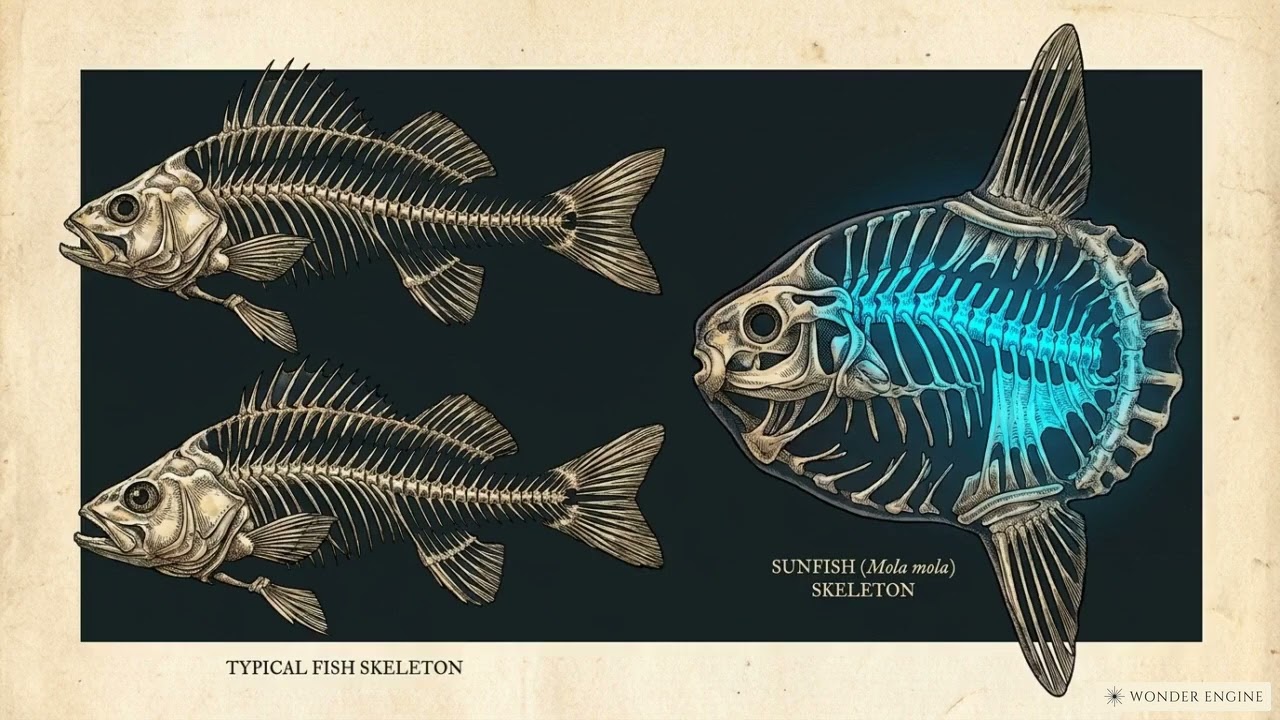
The Ocean Sunfish Releases 300 Million Eggs and Still Loses Ground
A single Mola mola female carries up to 300 million eggs, the highest fecundity in any vertebrate, yet the species is now listed as Vulnerable.

Why the Aye-Aye Taps Trees Eight Times a Second
The aye-aye survived being declared extinct in 1933. Today it is killed on sight in Madagascar for the very finger that keeps it alive.