
← Wonder EngineWonder no. 06Stranger beasts6min read
The Naked Mole-Rat and the Rules It Refuses to Follow
The story behind the wonder.
A hairless East African rodent lives past 37 years, almost never gets cancer, and feels no acid. The biology behind every loophole.
Published
UTC
Reading time
6 min
~210 wpm
Word count
1,332
plain English
Category
Stranger beasts
stranger-beasts
A small, hairless East African rodent has been documented living more than 37 years in captivity, and across multi-year observations of its colonies, not a single case of cancer was found.
A rodent that refuses to age
Heterocephalus glaber, the naked mole-rat, is roughly 8 to 10 centimetres long and weighs 30 to 35 grams. By the rules that govern almost every other small mammal, an animal that size should burn through its biology in a few years and be gone. A laboratory mouse of comparable mass lives only two or three. The next longest-lived rodent on record, the African porcupine, reaches about 28 years. The naked mole-rat has been documented past 37 in captivity.
The lifespan is only the headline. The deeper anomaly sits in the actuarial curve. In nearly every mammal studied, the risk of dying rises exponentially with age, a pattern formalized as the Gompertz-Makeham law of mortality. The naked mole-rat's mortality risk does not climb. It stays flat across the decades. An old mole-rat is no more likely to die this year than a young one.
In 2013, the journal Science named the species "Vertebrate of the Year," citing its extreme cancer resistance as the basis for the award. The species was not chosen for charm or rarity. It was chosen because it appeared to have written its way out of one of biology's most reliable death sentences.
A burrow under the Horn of Africa
The naked mole-rat lives in the drier tropical grasslands of East Africa, specifically beneath the soils of southern Ethiopia, Kenya, and the Somali regions of the Horn of Africa. It almost never surfaces. A single colony's tunnel network can stretch a cumulative three to five kilometres in length, threaded through earth that traps respired gases and starves the air of oxygen.
The numbers there are equally hostile. Oxygen concentration in the burrows runs as low as 2 to 9 percent, against the 21 percent of the open atmosphere. Most small mammals dropped into that air would be unconscious in minutes. Naked mole-rats live their entire lives in it.
The social architecture is just as strange. The species is one of only two eusocial mammals known to science, the other being the closely related Damaraland mole-rat. Eusociality in a mammal was first formally described in zoologist Jennifer Jarvis's 1981 paper in Science, titled "Eusociality in a Mammal: Cooperative Breeding in Naked Mole-Rat Colonies." A colony averages 75 to 80 individuals but can exceed 300. There is a single breeding queen, mated to one to three breeding males. Every other animal is a non-reproductive worker. The colony behaves less like a group of rodents than like a subterranean superorganism, with individual survival subordinated to the burrow.
The queen herself is a structural exception. Her vertebrae physically expand between births, lengthening her body to carry larger litters. In captivity, she can produce a litter roughly every 80 days after a gestation of around 70 days, with an average of 11 to 12 pups. The largest recorded litters reach 28 in the field and 27 in captivity.
The polymer that blocks the tumour
The mechanism of cancer resistance was identified in a landmark 2013 paper in Nature by Vera Gorbunova, Andrei Seluanov, and colleagues at the University of Rochester. They found that naked mole-rat tissue is saturated with a form of hyaluronan, the structural polymer many vertebrates produce around their cells, that is over five times larger than the version found in humans or mice.
This high-molecular-mass hyaluronan accumulates because the species' hyaluronan synthase 2 gene, HAS2, carries amino acid changes unique to the naked mole-rat, and because its tissues degrade the polymer unusually slowly. The result is a dense, oversized matrix sitting between every cell.
That matrix triggers a behaviour the researchers called early contact inhibition. Naked mole-rat cells, sensing each other through the polymer, stop dividing at far lower densities than mouse or human cells. They refuse to pile up. When the researchers stripped the polymer away using the enzyme hyaluronidase, the cells lost the property and proliferated freely, behaving like ordinary mammalian cells.
The clinical signal was even more striking than the cellular one. The 2013 paper reported that "multi-year observations of large naked mole-rat colonies did not detect a single incidence of cancer." The first documented malignant tumours in captive naked mole-rats were not described until 2016, in two zoo animals, and those animals had been kept at standard atmospheric oxygen of roughly 21 percent, against the 2 to 9 percent of their natural burrows. A 2023 study transferred a naked mole-rat hyaluronan synthase gene into laboratory mice and reported a 4.4 percent increase in median lifespan, along with improved resistance to spontaneous tumours.
Burning fructose, feeling no acid
Cancer resistance is one item on a longer list. The naked mole-rat survives for at least five hours at 5 percent oxygen without visible distress. It can live in an atmosphere of 80 percent carbon dioxide, provided the remaining 20 percent is oxygen, a mix that would be lethal to almost any other vertebrate. It can endure 18 minutes of zero oxygen with no detectable harm. In one published anoxia test, none of the animals survived a 30-minute exposure, so the upper bound sits somewhere between those two figures.
During anoxia, the animal's heart rate drops from roughly 200 beats per minute to about 50. More remarkably, its metabolism switches from burning glucose to burning fructose, a pathway otherwise restricted in nature to plants and a handful of microbes. The fructose route works in zero oxygen because it bypasses the acid buildup that normally shuts down anaerobic glucose breakdown in mammalian tissue.
Other rules give way too. The naked mole-rat feels no pain from acid burns or from capsaicin, the compound that gives chili peppers their heat, because its cutaneous sensory nerve fibres lack the neurotransmitter substance P that other mammals use to signal that class of pain. It is the only known mammalian thermoconformer, meaning its body temperature tracks the temperature of its surroundings, in the manner of a reptile, except above 29 degrees Celsius, where it switches into a homeothermic mode. About 25 percent of its muscle mass is dedicated to closing its jaws, which serve as digging tools, and its lips seal behind its protruding incisors so it does not swallow soil while tunnelling. Its resting metabolic rate sits at roughly 70 percent of a mouse's, and can be reduced by up to 25 percent during prolonged hunger.
A catalogue of loopholes in one body
The contradiction is not that any single trait exists. Other animals tolerate low oxygen. Other animals live in tight colonies. Other animals have unusual pain biology. The contradiction is that almost every rule mammalian biology has written for how a small rodent should die, cancer, ageing, suffocation, acid burns, appears to have a loophole, and a 30-gram, hairless, near-blind burrower in the soils of Ethiopia and Kenya carries all of them at once.
The first draft of the naked mole-rat genome was published in 2011, with an improved assembly in 2014. The species has a diploid chromosome number of 60. Sequence in hand, researchers have begun to read where these loopholes are written. The 2023 hyaluronan transfer experiment in mice is an early test of whether any of them can be moved. The 4.4 percent lifespan extension was modest, but the direction of travel was the point.
The animal itself does not know any of this. It is busy chewing roots in the dark, sharing a tunnel with seventy-nine relatives and one queen who will keep producing pups until she dies, which, statistically, she is in no particular hurry to do.
Sources
// Sources · primary references
03 refs- Wikipedia: Naked mole-raten.wikipedia.org
- Tian et al., High-molecular-mass hyaluronan mediates the cancer resistance of the naked mole rat, Nature, 18 July 2013nature.com
- Wikipedia: Eusocialityen.wikipedia.org
// More from Stranger beasts
See category →
The Parasite That Replaces a Fish's Tongue: Cymothoa exigua
A small isopod off Costa Rica severs a snapper's tongue, waits for the tissue to die, and clamps itself into the socket for up to three years.
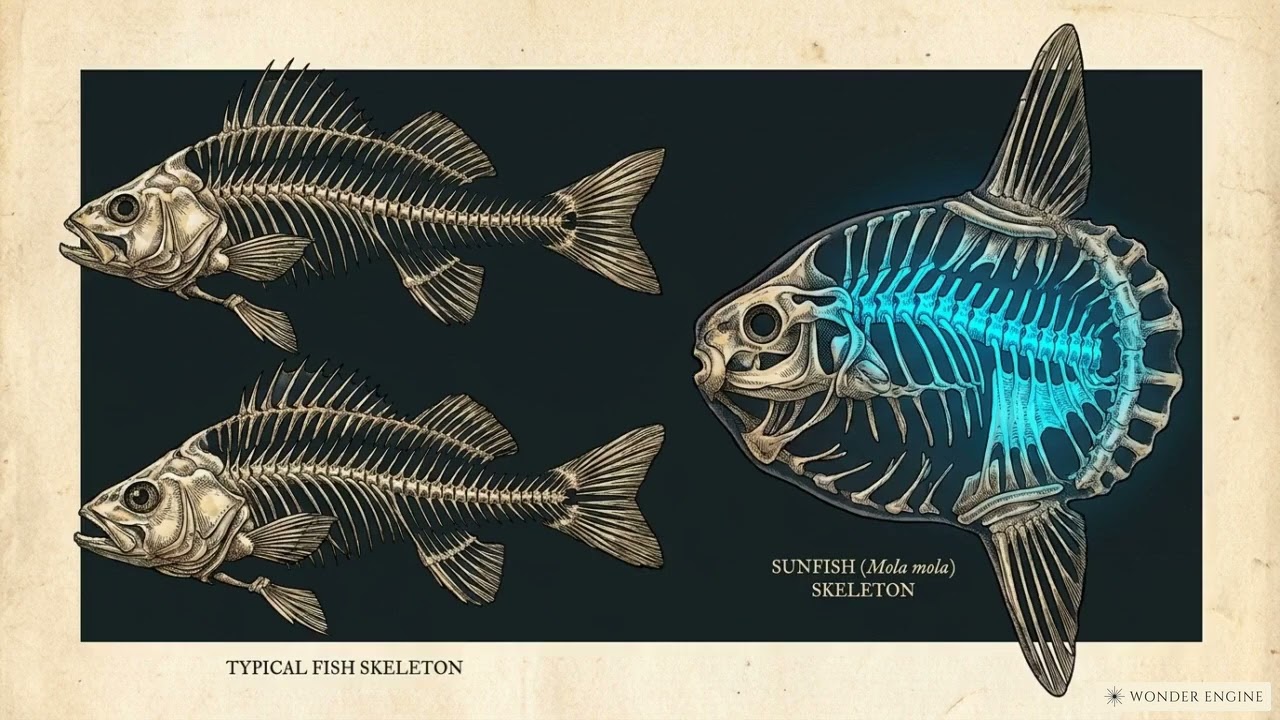
The Ocean Sunfish Releases 300 Million Eggs and Still Loses Ground
A single Mola mola female carries up to 300 million eggs, the highest fecundity in any vertebrate, yet the species is now listed as Vulnerable.

Why the Aye-Aye Taps Trees Eight Times a Second
The aye-aye survived being declared extinct in 1933. Today it is killed on sight in Madagascar for the very finger that keeps it alive.