
← Wonder EngineWonder no. 02Stranger beasts5min read
Why the Narwhal's Tusk Is Really a Tooth Wired With 10 Million Nerves
The story behind the wonder.
A narwhal's tusk is the left canine of the upper jaw, hollow, spiraling counter-clockwise, and wired with roughly ten million exposed nerve endings.
Published
UTC
Reading time
5 min
~210 wpm
Word count
1,126
plain English
Category
Stranger beasts
stranger-beasts
A narwhal's tusk is not a horn but a single tooth, the left canine of the upper jaw, that erupts forward through the animal's upper lip and carries roughly ten million exposed nerve endings into the open Arctic Ocean.
A tooth that grew the wrong way
Begin with what the tusk actually is. It is the left canine of the upper jaw in Monodon monoceros, a medium-sized toothed whale of the high Arctic. The tooth is hollow, and it grows continuously throughout the animal's life. In males it begins to erupt forward through the upper lip between two and three years of age. Fully formed, it reaches between 1.5 and 3 meters in length, or 4 feet 11 inches to 9 feet 10 inches, and can weigh up to 7.45 kilograms, about 16.4 pounds.
Then there is the geometry. The helical groove forms a left-handed spiral. On every tusk ever recorded, it twists counter-clockwise as viewed from the base toward the tip. The rule does not bend. Some males grow a second tusk when the right canine also erupts forward. Females rarely grow one at all, and when they do, the tooth is typically smaller and its spiral less pronounced.
What is strange about a narwhal tusk is not the strict geometry, though. Most mammal teeth sit safely behind a hard enamel shell, with sensitive tissue sealed deep inside. This one is built the opposite way. Microscopic tubules run from the inner pulp straight to the exterior, pushing nerve tissue into direct contact with freezing seawater. It is a delicate internal structure inverted into one of the most abrasive environments on Earth.
Where it lives, and in what numbers
The narwhal lives only in the Arctic. Its range covers the Canadian Arctic Archipelago, Hudson Bay, and Baffin Bay on the western side of the basin, and the east coast of Greenland, Svalbard, Franz Joseph Land, and Severnaya Zemlya on the eastern. The most northerly confirmed sightings sit at about 85 degrees north, near Franz Joseph Land, deep within drifting pack ice.
The IUCN's 2017 assessment estimated the global population at approximately 170,000 narwhals, with about 123,000 mature adults, and listed the species as Least Concern. The subpopulations are not evenly distributed. The Baffin Bay group contains around 140,000 narwhals on its own. The northern Hudson Bay subpopulation numbers only about 12,500.
The animal's seasonal behavior is more confined than those numbers suggest. During the winter, the species moves offshore into deep water beneath continuous pack ice. On those winter foraging grounds, less than 5 percent of the sea surface is open water. The entire global population spends months breathing through narrow fissures and wider cracks called leads, surviving under a ceiling of ice that shifts and closes without warning. When the ice closes faster than the herd can move, narwhals can suffocate in mass entrapment events. In the winter of 1914 to 1915, approximately 1,000 narwhal carcasses were recovered from a single such event in the Canadian Arctic.
The Harvard work and the ten million nerves
The reclassification of the tusk as something other than a weapon comes out of peer-reviewed research led by Martin Nweeia, a dental anatomist at the Harvard School of Dental Medicine, working with colleagues. Their characterization, summarized in the literature, is that the narwhal tusk is a "highly innervated sensory organ with millions of nerve endings." The working estimate is roughly ten million.
What those nerves are doing has also been worked out. Studies from this line of research argue the tusk can detect temperature variability and changes in salinity and pressure in the surrounding water. In effect, the animal is dragging a hypersensitive environmental antenna through the sea ahead of itself, reading the column it is about to enter. That is the first reason to stop calling the tusk a horn.
The second reason came in 2016. Drone footage filmed in Tremblay Sound, in the Canadian Arctic, captured narwhals using their tusks to "tap and stun small Arctic cod" before feeding, in the language used by World Wildlife Fund Canada and Fisheries and Oceans Canada when the observations were reported. It was the first direct video evidence of the tusk being used in foraging. The instrument is not only a sensor. It is also, occasionally, a blunt tool used to subdue prey in the dark.
Two thousand meters down, and back through the ice
The animal that carries this tooth is built for depth. Narwhals are among the deepest-diving marine mammals known. They routinely descend below 800 meters, about 2,620 feet, more than fifteen times a day. Many working dives reach 1,500 meters, roughly 4,920 feet. The greatest recorded narwhal dive reached 2,370 meters, about 7,780 feet below the surface. A single dive can last up to 25 minutes.
The prey at those depths is consistent. The narwhal's diet is dominated by Greenland halibut, Arctic cod, polar cod, cuttlefish, shrimp, and armhook squid. Foraging at a kilometer and a half down, in near-total darkness, is the daily work. The tusk's reading of temperature, salinity, and pressure is not an abstraction in that environment; it is the same kind of information a pilot reads on instruments while flying through cloud.
Above the animal, the threat is geometric rather than hydrostatic. The pack ice may be open in a narrow lead one hour and sealed the next. The 1914 to 1915 event in the Canadian Arctic, which yielded around 1,000 carcasses from a single entrapment, is the most cited example of what closing ice can do to a herd that has committed itself to a winter ground.
This biological reality was hidden for centuries behind a single phrase. Arctic mariners called the animal "the unicorn of the sea." Medieval European traders bought tusks brought down out of the Arctic and sold them across the continent as the horns of true unicorns. The market predated the science by hundreds of years.
A sensory instrument in the shape of a weapon
The paradox holds at the end. The narwhal carries the strangest tooth in the mammal world, a left canine that grew forward through its own face, hollow, helical, weighing as much as 16.4 pounds, and wired with roughly ten million nerve endings open to the sea. The tooth reads the ocean it moves through. It also, when needed, strikes small fish to stun them. The animal that carries it lives under a ceiling of ice that stays closed more than 95 percent of the winter, dives to 2,370 meters, and was sold across Europe for centuries as a unicorn.
The instrument is sensory. The shape is a spear. The habitat is changing faster than almost any other ocean on Earth.
Sources
// Sources · primary references
02 refs- Wikipedia: Narwhalen.wikipedia.org
- National Geographic: Narwhalnationalgeographic.com
// More from Stranger beasts
See category →
The Parasite That Replaces a Fish's Tongue: Cymothoa exigua
A small isopod off Costa Rica severs a snapper's tongue, waits for the tissue to die, and clamps itself into the socket for up to three years.
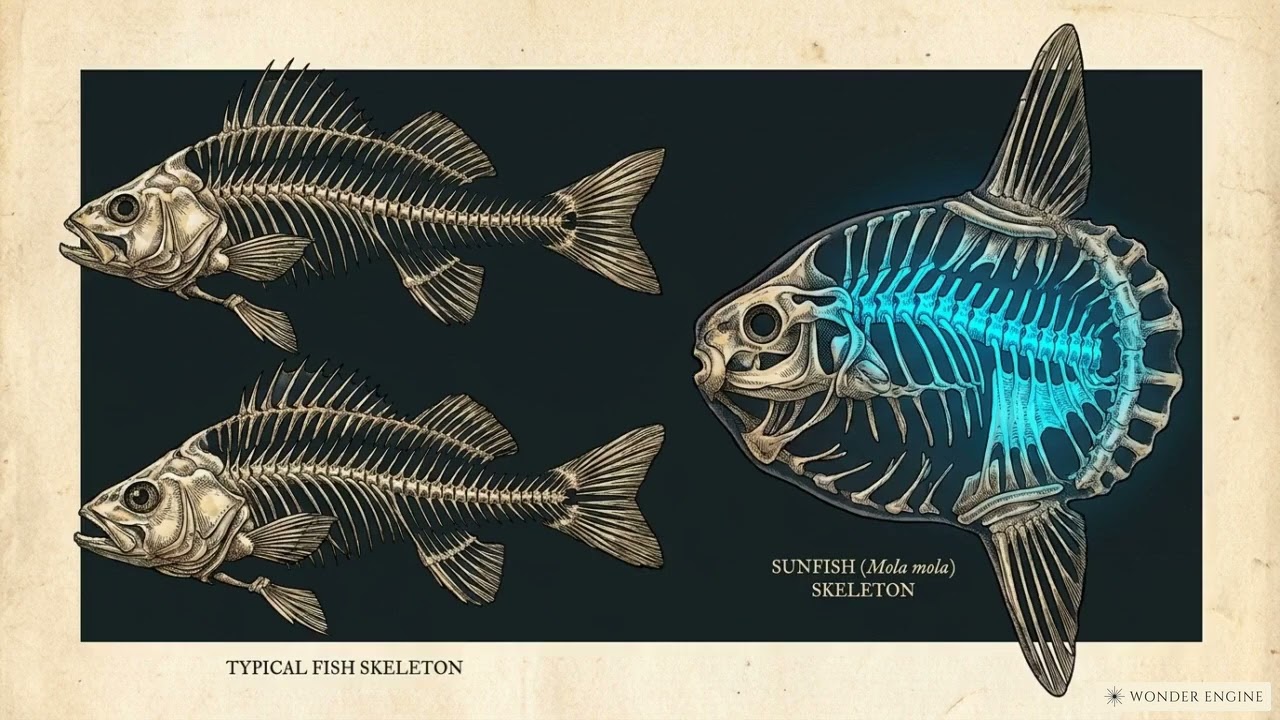
The Ocean Sunfish Releases 300 Million Eggs and Still Loses Ground
A single Mola mola female carries up to 300 million eggs, the highest fecundity in any vertebrate, yet the species is now listed as Vulnerable.

Why the Aye-Aye Taps Trees Eight Times a Second
The aye-aye survived being declared extinct in 1933. Today it is killed on sight in Madagascar for the very finger that keeps it alive.